Success message
Error message
Why are abandoned buildings so creepy? Why do empty houses feel haunted—even when they’re not?
You’re not imagining it. Many people feel a strong and immediate reaction to empty or abandoned spaces—especially when they appear intact but unused.
A house with furniture still in place. A room that looks ready, but hasn’t been used. A building that feels paused rather than finished.
A school playground with no children. At night. A hospital ward left ready but unused. An abandoned petrol station at the edge of a road. A drive-in cinema with no cars.
It’s not just “creepy.” It’s something more physical— a distinct, visceral sense that something is wrong.

Abandonment takes different forms depending on what the building or site was meant to do. The underlying effect is the same—but the emphasis shifts.
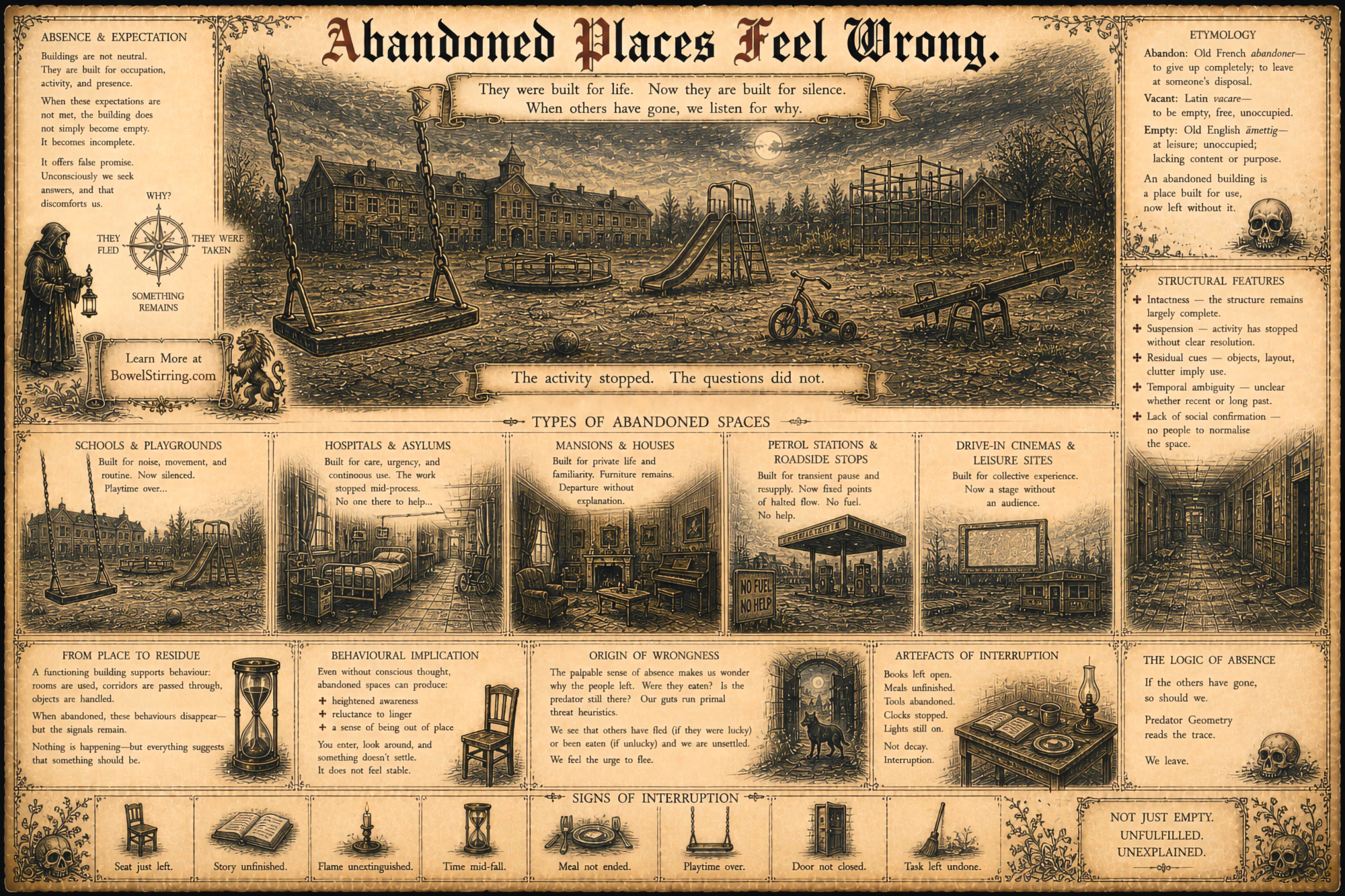
A school implies noise, movement, and routine. Classrooms, corridors, and playgrounds are built for constant activity. When empty, they feel abruptly silenced. The absence is not quiet—it is interrupted. The children have gone...
Hospitals imply urgency, care, and continuous use. Equipment, beds, and corridors suggest ongoing intervention. When abandoned, these signals persist without resolution. The space feels unfinished, as if activity has ceased mid-process. There is no one there to help...
A house implies habitation—daily routines, private life, and familiarity. When furniture remains but occupants do not, the space feels paused rather than empty. It suggests departure without explanation.
These are transient by design—places of brief pause within movement. When abandoned, they become fixed points of halted flow. The expectation of arrival and departure remains, but nothing arrives. And there is no fuel, which makes them dangerous to rely on.
These spaces are built for collective experience—gathering, watching, waiting. When empty, the infrastructure remains but the audience is gone. The space becomes a stage without performance.

Buildings are not neutral. They are built for occupation, activity, and presence.
A house implies inhabitants, routines, and movement.
A hospital implies care, urgency, and constant use
When these expectations are not met, the building does not simply become empty. It becomes incomplete. An abandoned space is not just unused—it is unfulfilled. It offers false promise. Unconsciously we seek answers, and that discomforts us.
The word abandon comes from Old French abandoner, meaning “to leave at someone’s disposal” or “to give up completely.” To abandon something is not just to leave it—but to withdraw responsibility from it.
Vacant comes from Latin vacare—to be empty, free, or unoccupied.
Empty derives from Old English ǣmettig, meaning “at leisure” or “unoccupied,” but over time has come to mean lacking content or purpose.
An abandoned building is therefore a place built for use, now left without it.
Abandoned spaces tend to share certain properties:
intactness — the structure remains largely complete
suspension — activity has stopped without clear resolution
residual cues — furniture, objects, or layout still imply use
temporal ambiguity — unclear whether abandonment is recent or long past
lack of social confirmation — no people to normalise the space
These features create a mismatch between:
what the building suggests and
what is actually happening
A functioning building supports behaviour:
rooms are use
corridors are passed throug
objects are handled
When abandoned, these behaviours disappear—but the signals remain. The building becomes a structure full of cues, but no activity to resolve them. This produces a particular kind of tension. Nothing is happening—but everything suggests that something should be.
Even without conscious thought, abandoned spaces can produce:
heightened awareness
reluctance to linger
a sense of being out of place
The reaction is often immediate. You enter, look around, and something doesn’t settle. The space is not dangerous. But it does not feel stable.
The palpable sense of absence makes us wonder why the people left. Were they eaten? Is the predator still there? This sounds ludicrous in a modern setting, but our guts run primal threat heuristics. We see that others have fled (if they were lucky) or been eaten (if unlucky) and we are unsettled. We feel the urge to flee. This emphatic abandonment triggers our Predator Geometry alerts, creating a bowel stirring response.
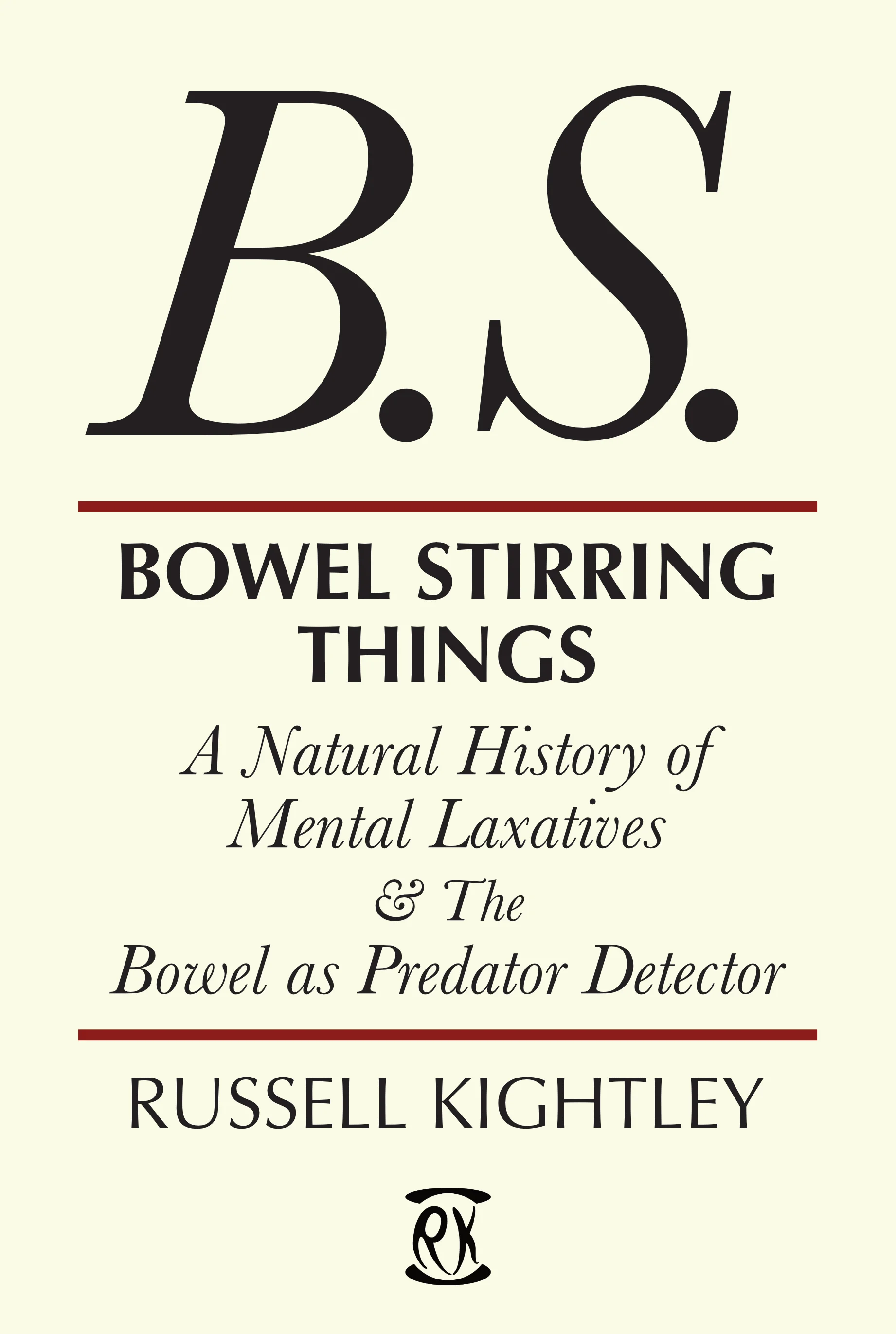
In 1996, Russell Kightley completed a manuscript on what he called “bowel stirring things.” It remained unpublished for thirty years.
In 2026, he revived and refined it as Bowel Stirring Things: A Natural History of Mental Laxatives & The Bowel as Predator Detector—a study of unsettling places and the geometries that provoke an immediate, visceral response.