Success message
Error message
Why do certain places feel wrong the moment you enter them?
A long corridor with no people. A wide, empty floor under harsh light. A doorway leading somewhere you cannot see. A space that looks functional, complete—and yet unsettled.
You’re not imagining it. Many environments produce a quiet but unmistakable reaction. Not fear. Not panic. Not even conscious concern. Just a low, internal signal that something about the space does not resolve. You hesitate. You orient yourself. You feel a subtle urge to move—either forward with caution, or away entirely.
Nothing has happened. Nothing is obviously wrong.
What feels wrong is often a direct response to the way a space is arranged—the relationship between surfaces, openings, distances, and lines of movement. Or the sense that something has perturbed the space—something has passed through and left a trace.
A recurring set of spatial conditions produces the same bowel stirring signal. I call it Predator Geometry—the measure of predators in the landscape.

Predator Geometry is the spatial arrangement that mirrors ancestral threats—where movement is constrained, visibility is uncertain, and exposure is uneven. These are primal traps.
Predator Geometry also includes perturbed geometry—a landscape modified by a predator. This is the trace of a predator, as distinct from a trap. The shimmering sense of a footprint. The hot breath of the monster. The dropped scale. The scratches on the rock.
I define predator geometry as spatial arrangements that signal latent threat. Our bowels are stirred by this geometry.
Geometry is the perfect word because it comes from geo (Earth) + metry (measure): literally, the measure of landscape. Geometry now extends to more abstract relations—lines, angles, surfaces, and the arrangement of parts. These configurations are what unsettle us. Our primal threat heuristics decode Predator Geometry. The bowel stirring response is the body sensing that geometry.
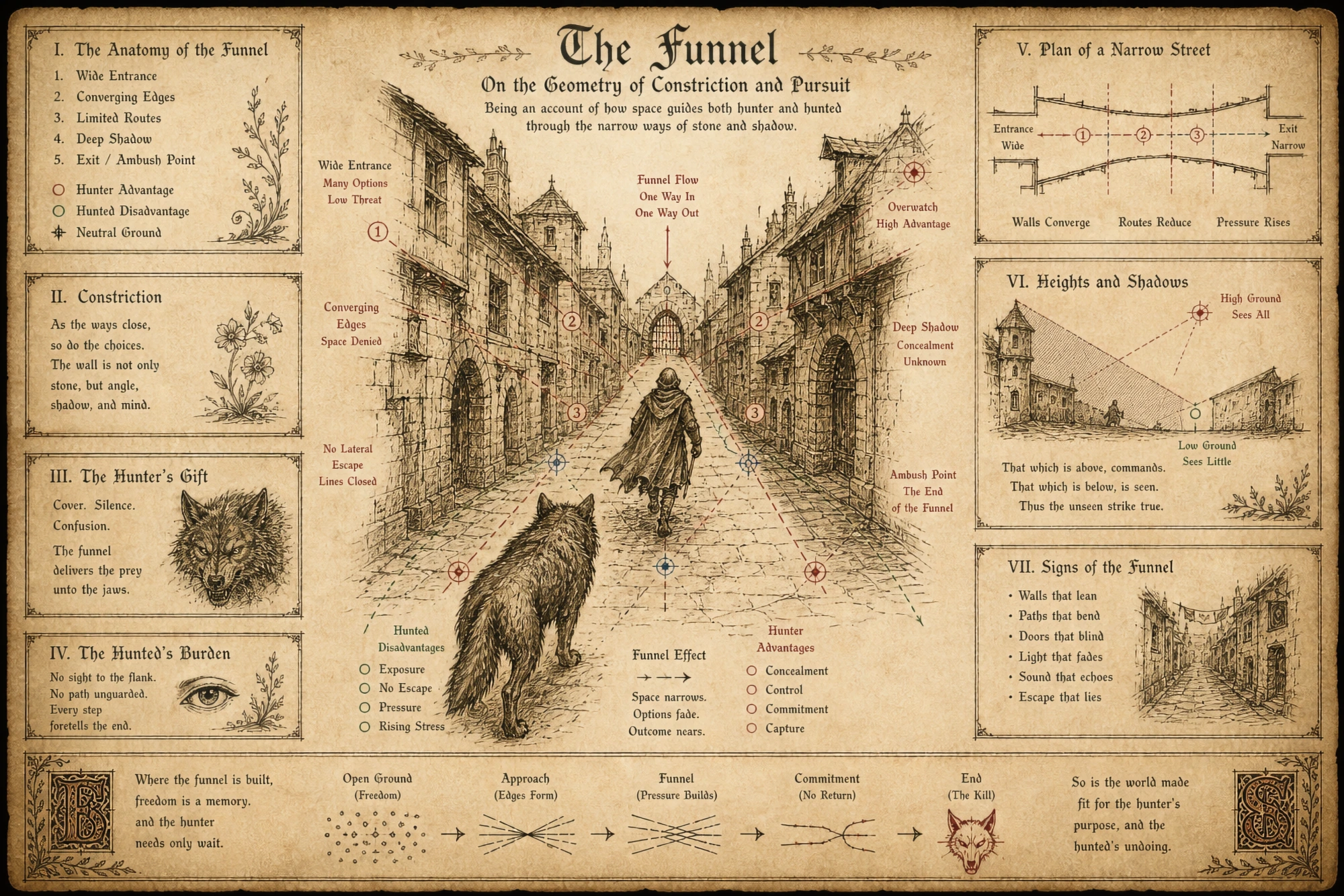
Narrowing corridors. Aisles. Bridges. Straits. Tunnels. Lifts (elevators). Valleys. Passageways. Funnels constrain movement and reduce options. They commit you to a direction before you have full information. You are moving—but not freely.
Funnels feel wrong. The Predator Geometry might be subtle, but the body is attuned to it.
Mazes and labyrinths are multiplied funnels, they twist and turn to trap their prey. They are full of dead ends and limited line-of-sight. So-called backrooms are a modern version of the Minotaur's trap.
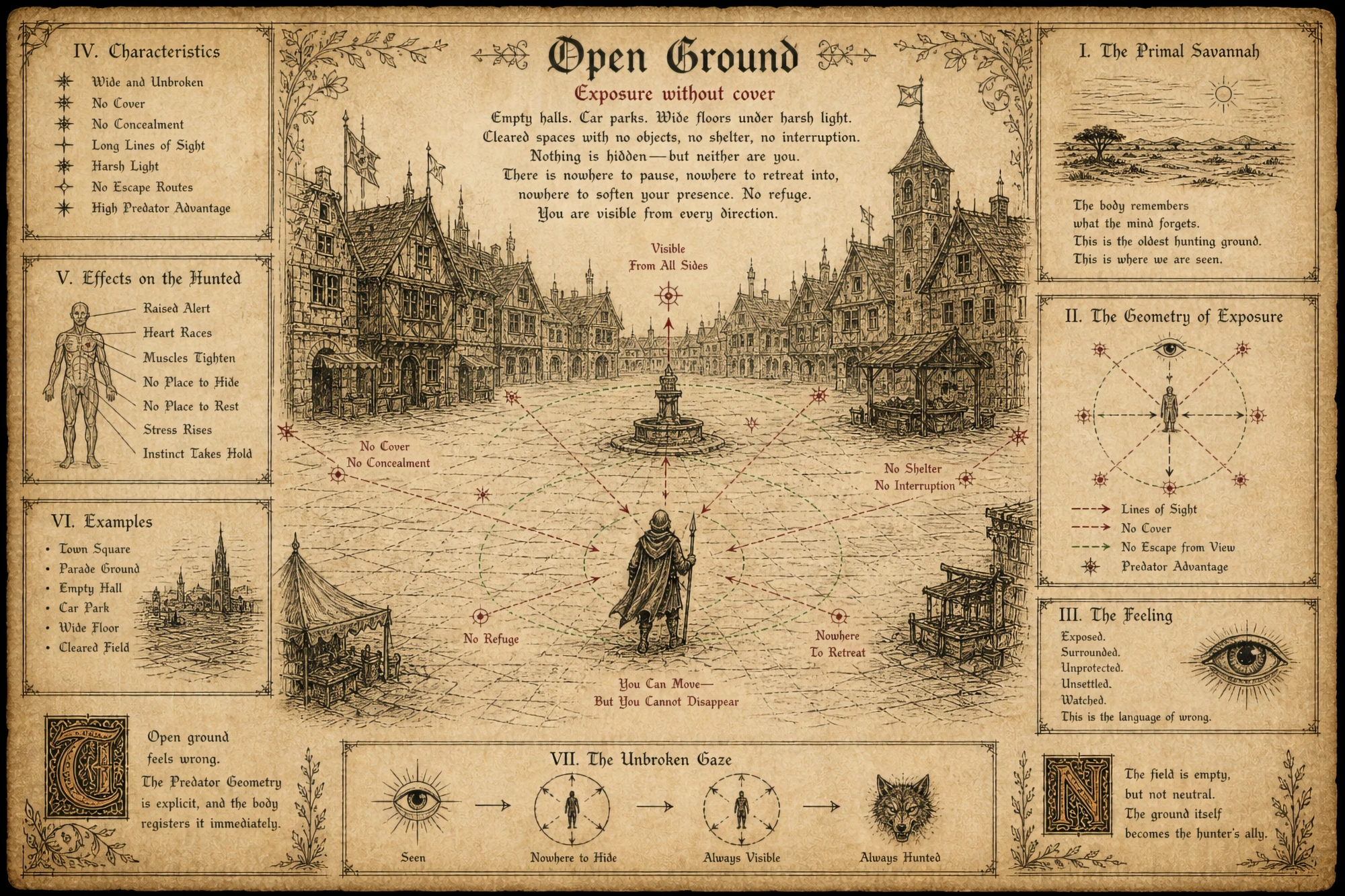
Empty halls. Car parks. Wide floors under harsh light. Cleared spaces with no objects, no shelter, no interruption. Nothing is hidden—but neither are you. There is nowhere to pause, nowhere to retreat into, nowhere to soften your presence. No refuge. You are visible from every direction.
You can move—but you cannot disappear.
Open ground feels wrong. The Predator Geometry is explicit, and the body registers it immediately.
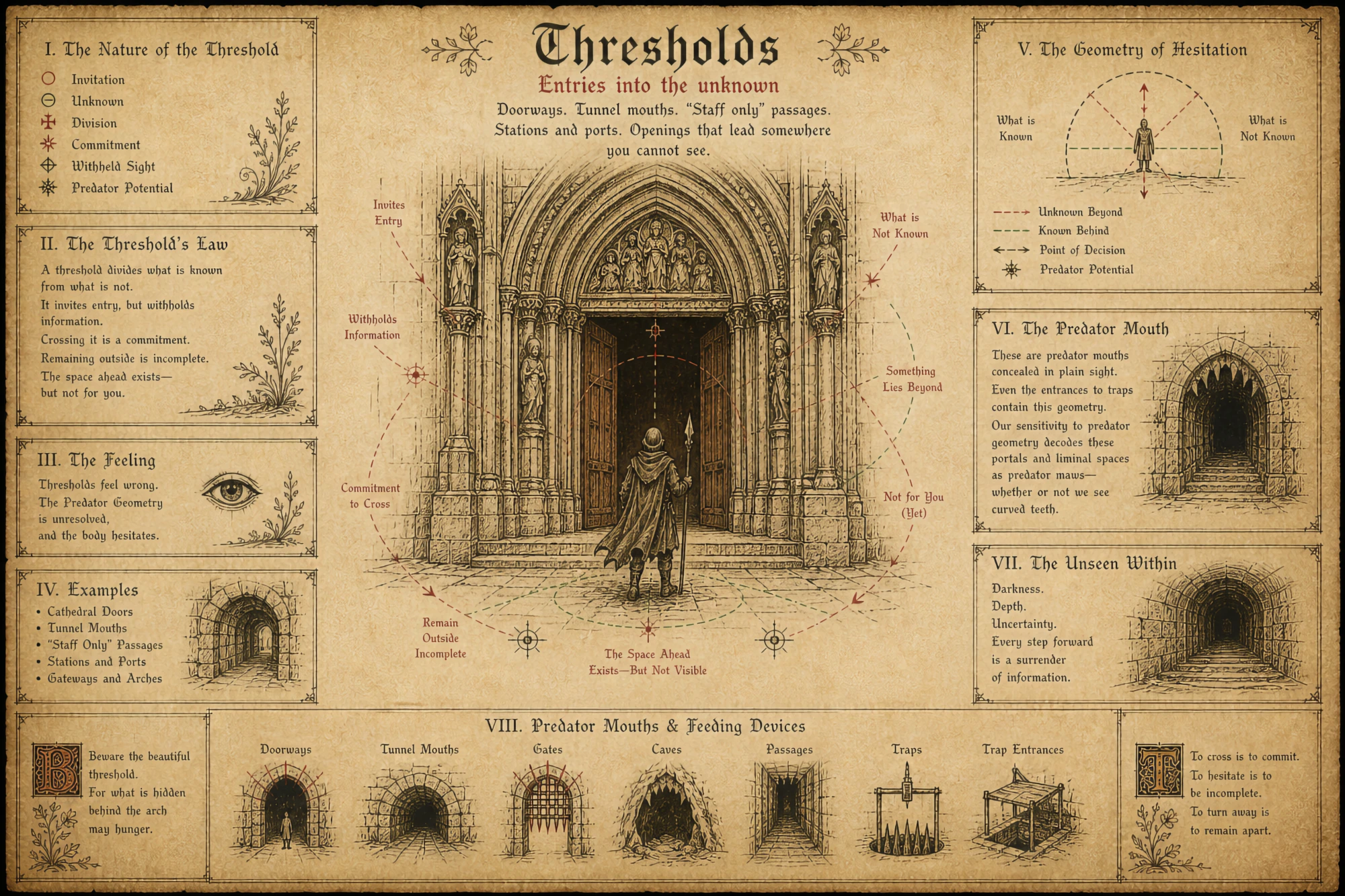
Doorways. Tunnel mouths. “Staff only” passages. Stations and ports. Openings that lead somewhere you cannot see.
A threshold divides what is known from what is not. It invites entry, but withholds information. Crossing it is a commitment. Remaining outside is incomplete. The space ahead exists—but not for you.
Thresholds feel wrong. The Predator Geometry is unresolved, and the body hesitates.
These are predator mouths concealed in plain sight. Even the entrances to traps contain this geometry. Our sensitivity to Predator Geometry decodes these portals and liminal spaces as predator maws—whether or not we see curved teeth. They are literally liminal (limen=threshold).
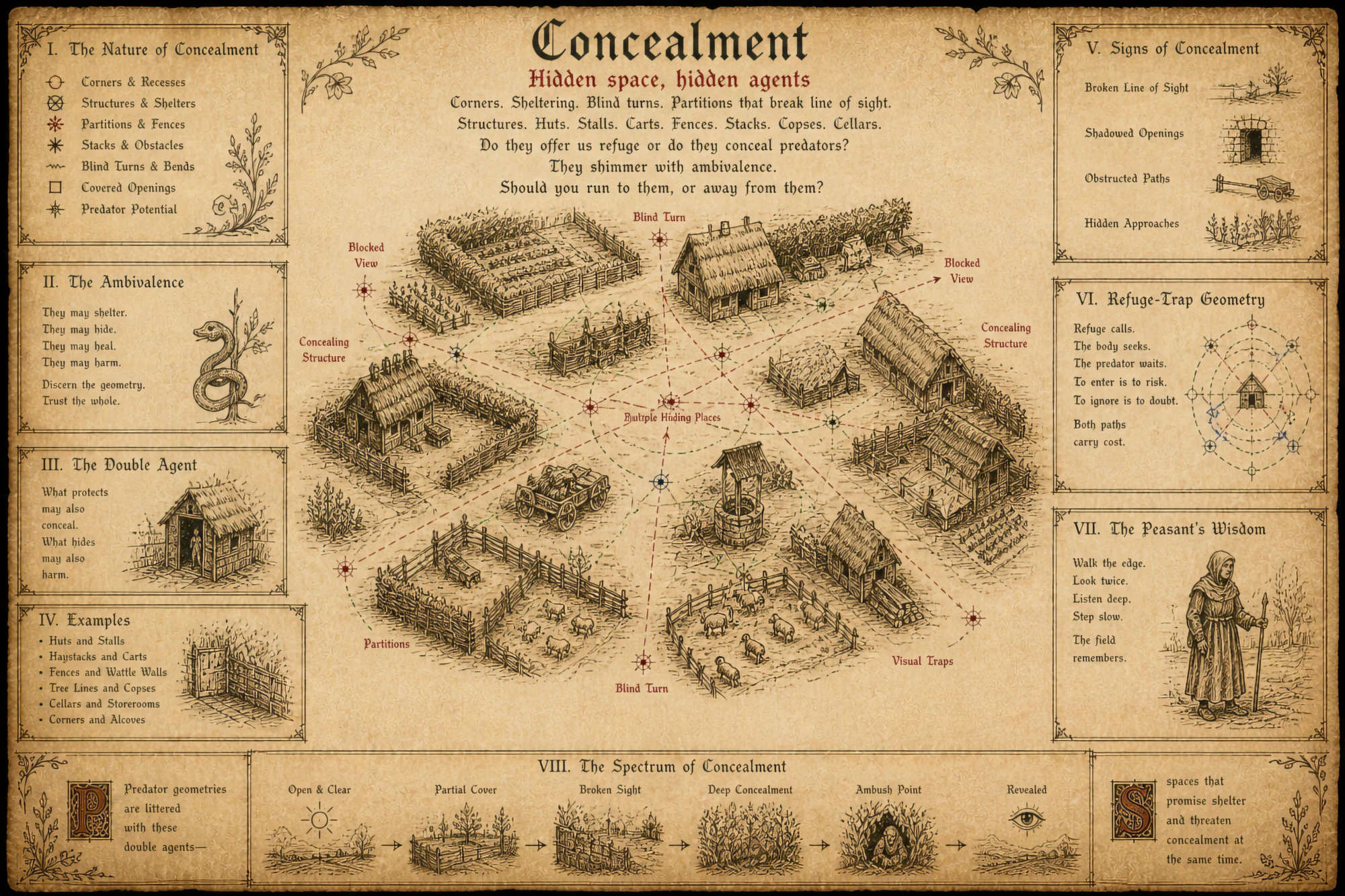
Corners. Shelving. Blind turns. Partitions that break line of sight. Structures. Boxes. Kiosks. Wardrobes. Capsules. Cars. Locked rooms. Do they offer us refuge or do they conceal predators? They shimmer with ambivalence. Should you run to them, or away from them?
Predator geometries are littered with these double agents—spaces that promise shelter and threaten concealment at the same time.
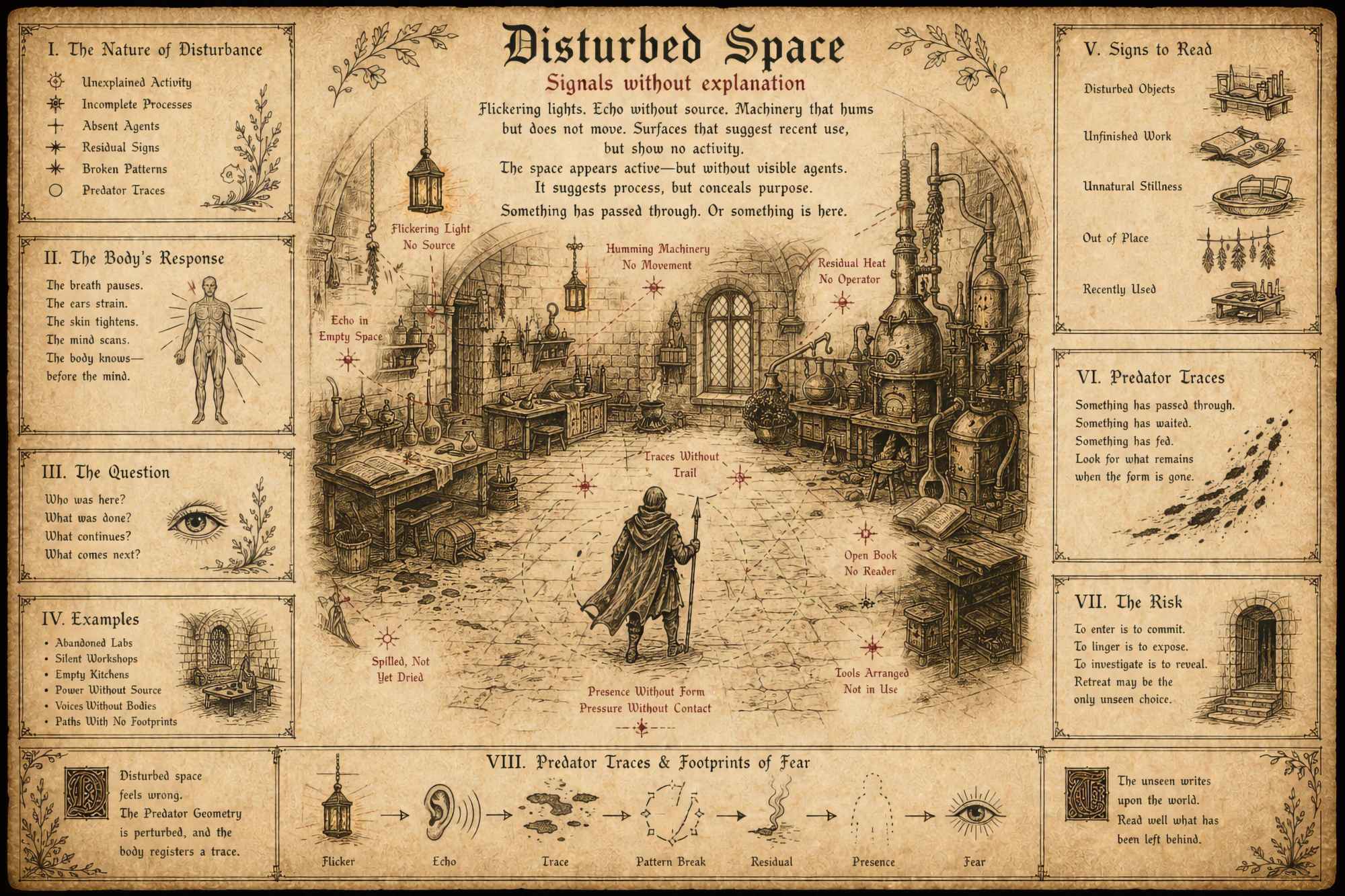
Flickering lights. Echo without source. Machinery that hums but does not move. Surfaces that suggest recent use, but show no activity.
The space appears active—but without visible agents. It suggests process, but conceals purpose.
Someting has passed through. Or something is here.
Disturbed space feels wrong. The Predator Geometry is perturbed, and the body registers a trace.

Identical doors. Endless corridors. Repeated rooms under uniform light.
Repetition removes distinction. It erases landmarks. It prevents mapping. The space does not guide you. It absorbs you.
Repetition creates cognitive blur—a visual stutter. Arrayed structures hint at a pack—a group of predators. In military terms, a battle formation or ranks of soldiers. Or a swarm—a multitude of predators. And such hostile agents might be spawning. This moves beyond individual predation to species-level displacement.
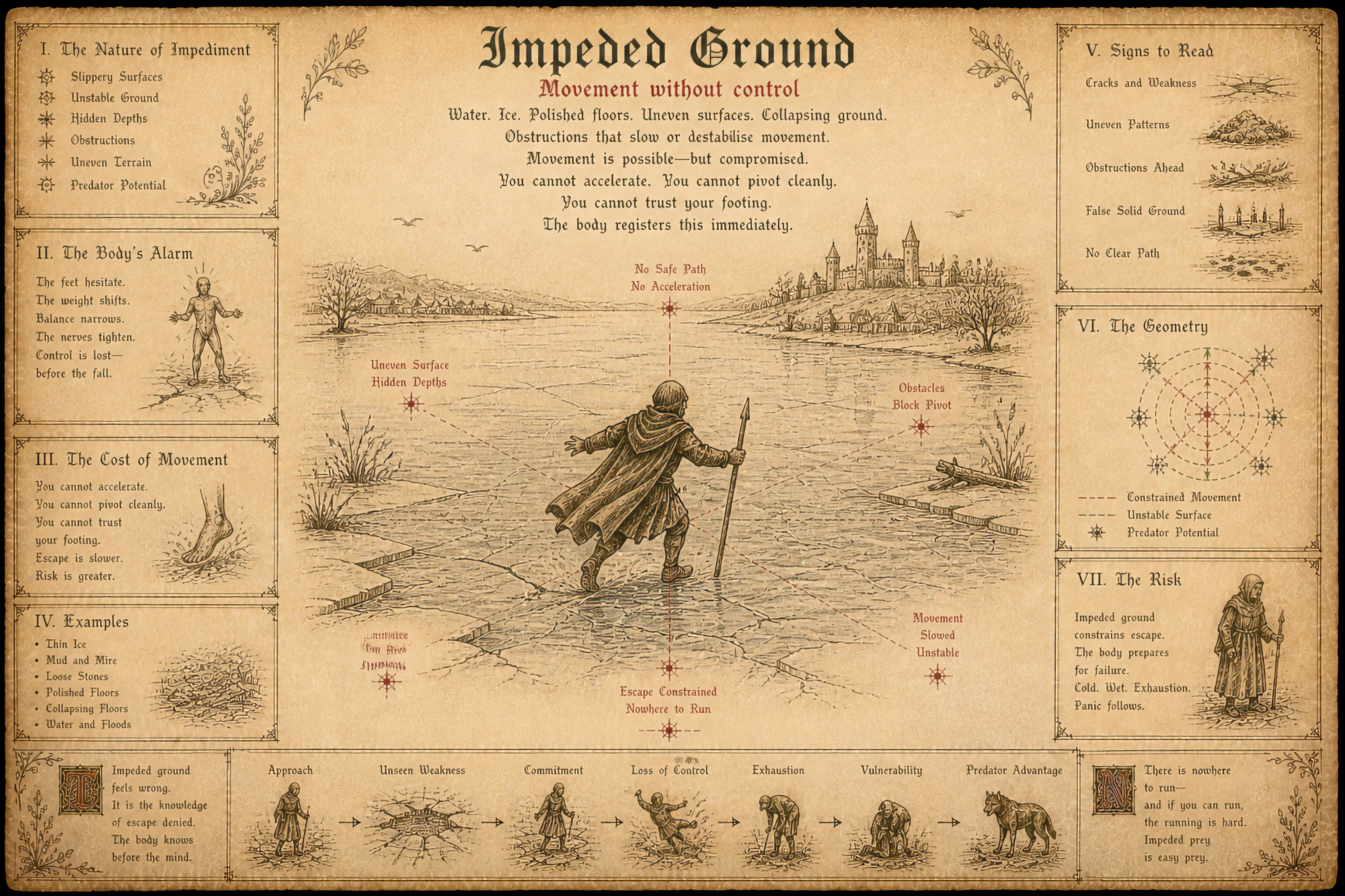
Water. Ice. Polished floors. Uneven surfaces. Collapsing ground. Obstructions that slow or destabilise movement. Movement is possible—but compromised. You cannot accelerate. You cannot pivot cleanly. You cannot trust your footing.
The body registers this immediately.
Impeded ground feels wrong. The Predator Geometry constrains escape, and the body prepares for failure.
This is bowel stirring triggered by compromised escape. There is nowhere to run—and if you can run, the running is hard.
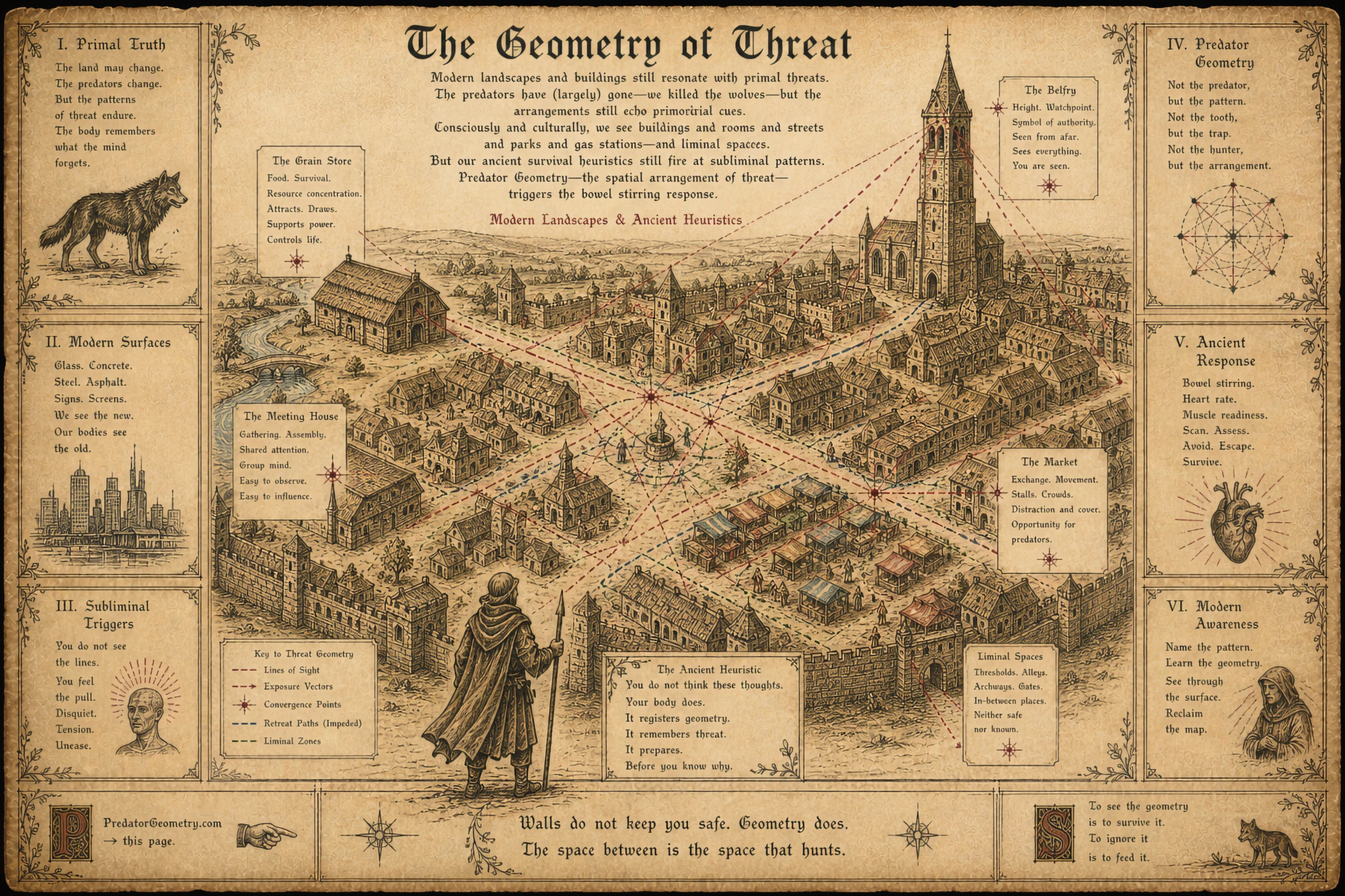
Modern landscapes and buildings still resonate with primal threats. The predators have (largely) gone—we killed the wolves—but the arrangements still echo primordial cues. Consciously and culturally, we see buildings and rooms and streets and parks and gas stations—and liminal spaces. But our ancient survival heuristics still fire at subliminal patterns. Predator Geometry—the spatial arrangement of threat—triggers the bowel stirring response.
PredatorGeometry.com → this page.
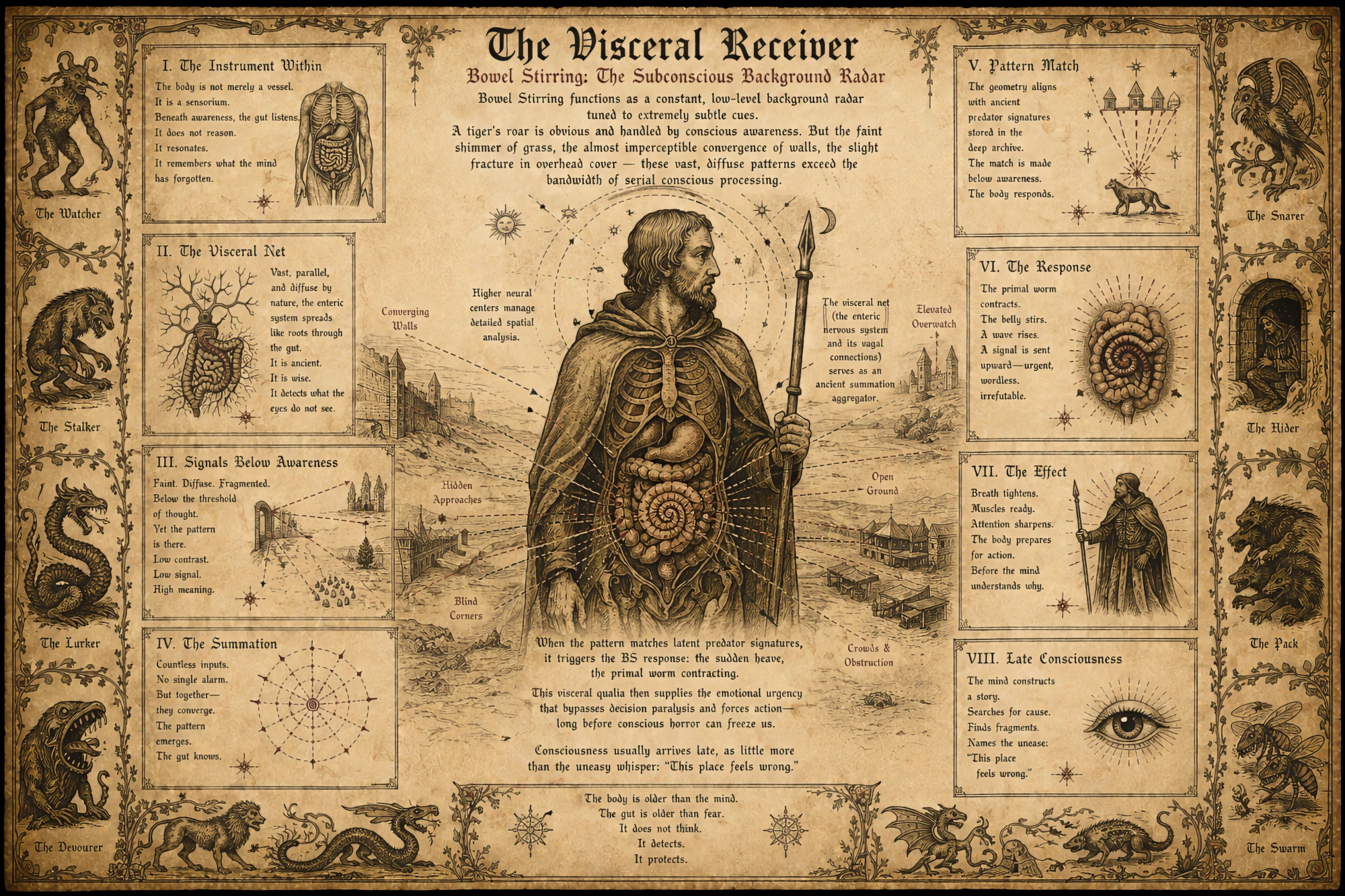
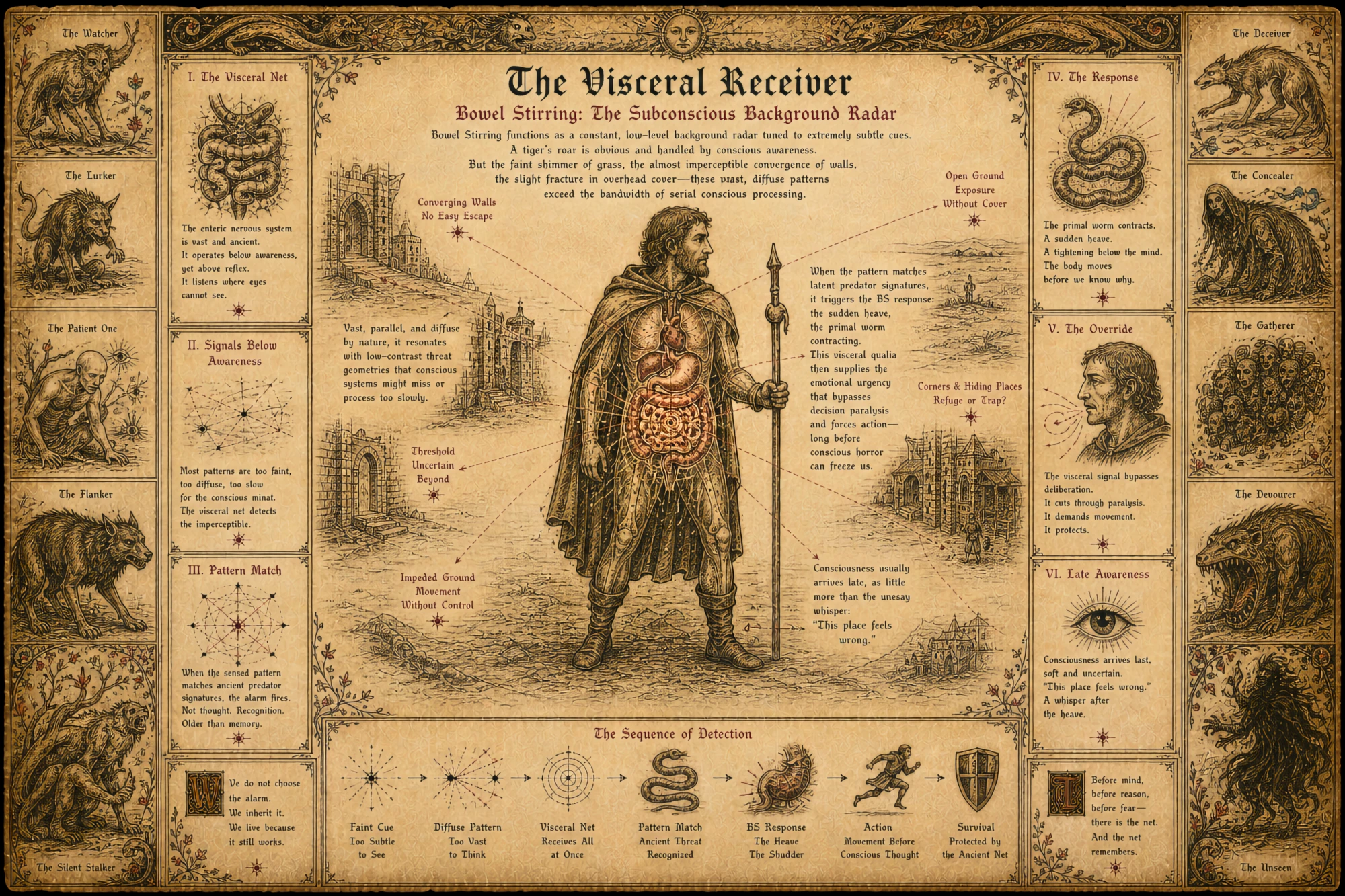
Bowel Stirring functions as a constant, low-level background radar tuned to extremely subtle cues.
A tiger’s roar is obvious and handled by conscious awareness. But the faint shimmer of grass, the almost imperceptible convergence of walls, the slight fracture in overhead cover — these vast, diffuse patterns exceed the bandwidth of serial conscious processing.
Higher neural centers manage detailed spatial analysis, but the visceral net (the enteric nervous system and its vagal connections) serves as an ancient summation system. Vast, parallel, and diffuse by nature, it resonates with low-contrast threat geometries that conscious systems might miss or process too slowly.
When the pattern matches latent predator signatures, it triggers the BS response: the sudden heave, the primal worm contracting. This visceral qualia then supplies the emotional urgency that bypasses decision paralysis and forces action — long before conscious horror can freeze us.
Consciousness usually arrives late, as little more than the uneasy whisper: “This place feels wrong.”
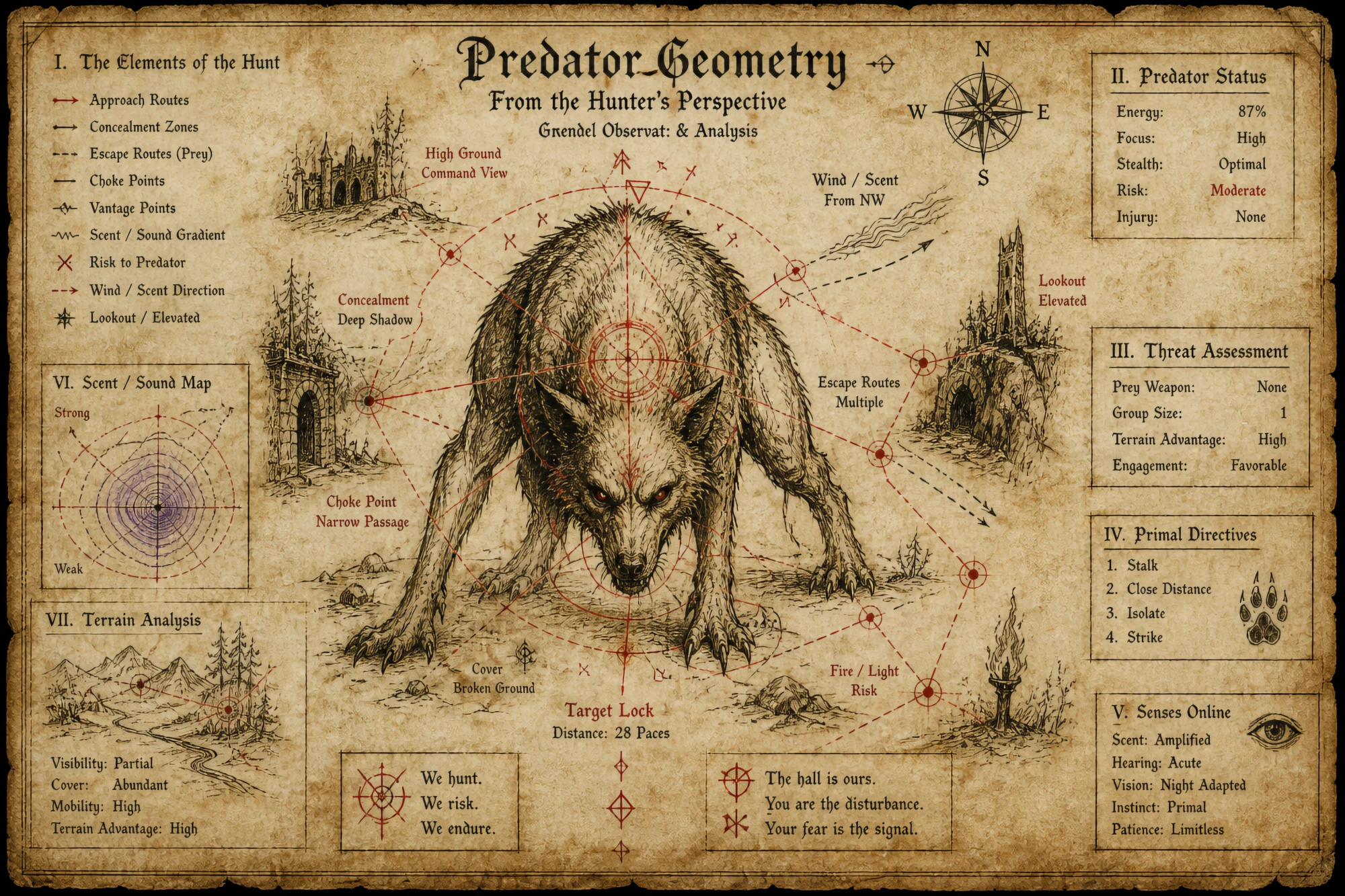
Like many things in the B.S., Predator Geometry is double-edged. Both hunter and hunted must parse the landscape for threats and opportunities.
The predator must trap the prey—but also account for danger to itself. Hunting carries the risk of a mortal wound. The hunter must eat and escape the kill unharmed.
These primal heuristics—ancient pattern-recognition systems—run the calculus for every hunt.
Predator and prey occupy the same space—the same geometry. They read it differently.
Part of the shimmer of the Bowel Stirring Response may lie here: we run both sets of heuristics in parallel.
In 1996, Russell Kightley completed a manuscript on what he called “bowel stirring things.” It remained unpublished for thirty years.
In 2026, he revived and refined it as Bowel Stirring Things: A Natural History of Mental Laxatives & The Bowel as Predator Detector—a study of unsettling places and the geometries that provoke an immediate, visceral response.