Success message
Error message
Why do empty parking garages feel creepy? Why do multi-storey carparks feel strange when they’re empty or quiet?
You’re not imagining it. Many people notice a distinct shift in how parking garages feel when they are empty—especially at night or between periods of use.
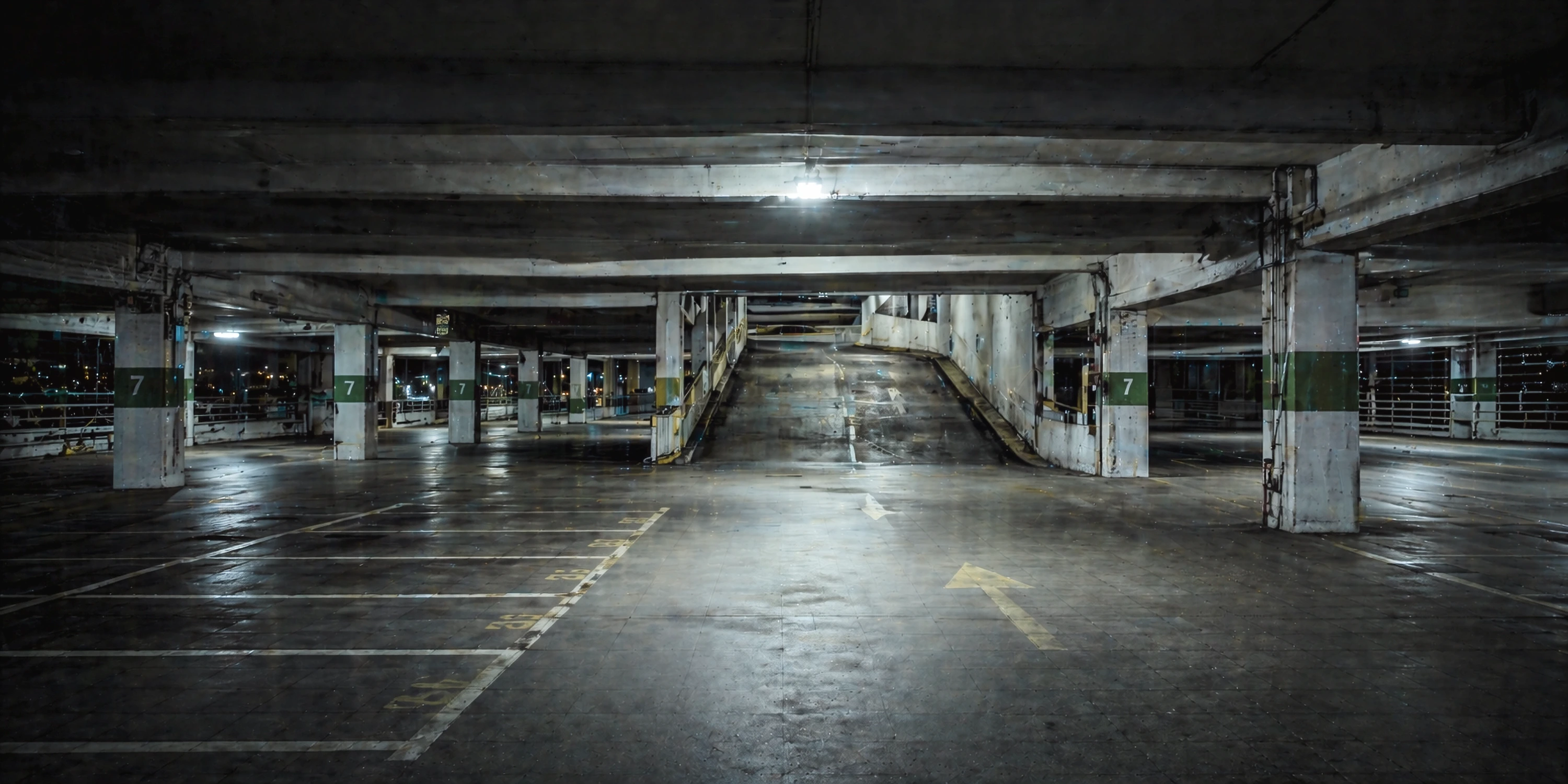
A multi-storey carpark with no cars. A concrete level with lights humming overhead. A ramp leading up or down, with no movement.
It’s not just emptiness. It’s something more immediate— a subtle, hard-to-explain sense that the space is not quite right.
Carparks are built for flow. They are designed to:
guide vehicles through constrained paths
organise temporary storage
support constant arrival and departure
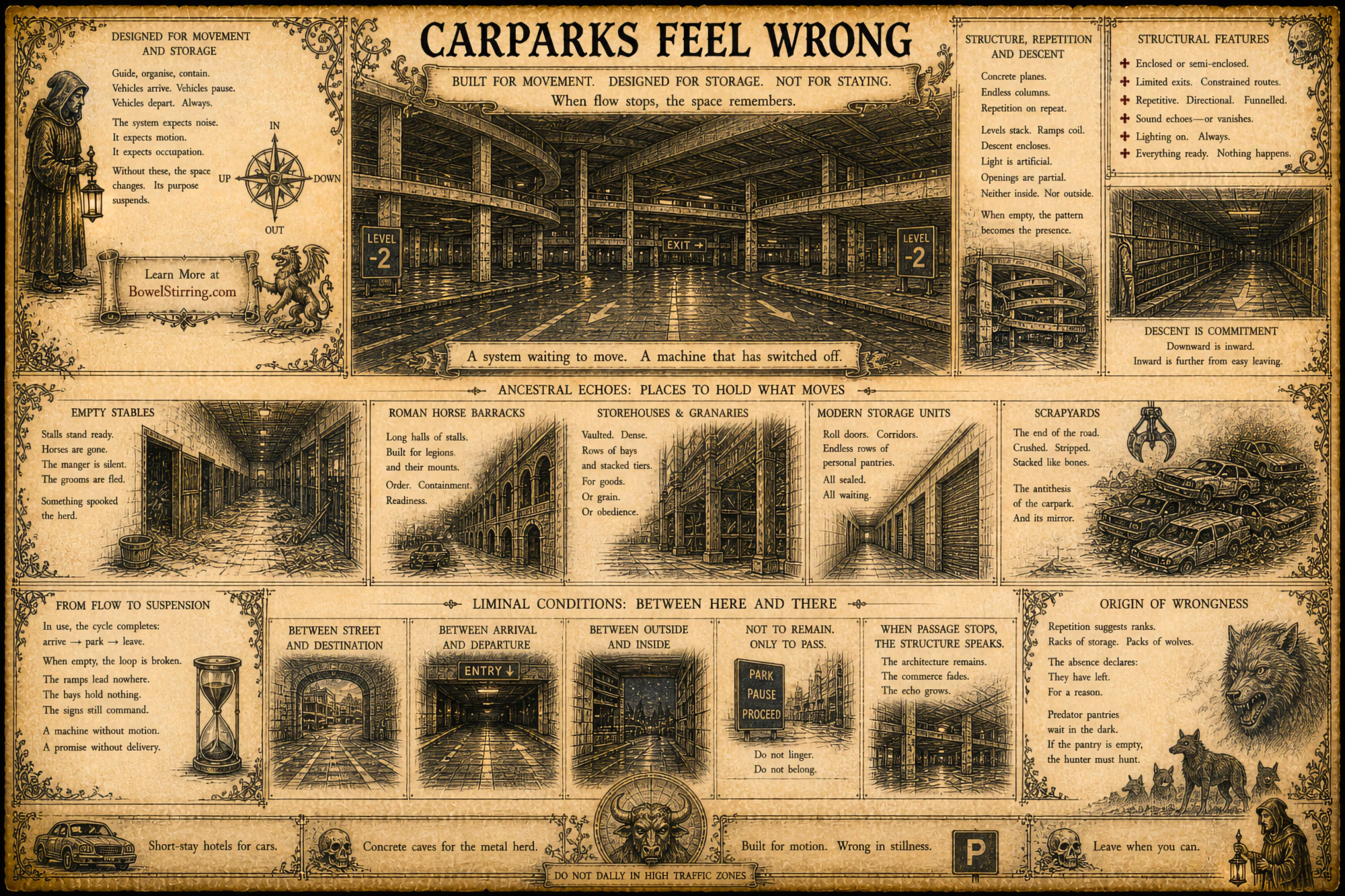
Their structure assumes: movement, noise, and occupation. When these are absent, the space changes. The layout remains, but its purpose is suspended. But the lack creates a weird echo, like an unnoticed machine that has switched off—a kind of negative noise.
Multi-storey carparks share a distinctive architecture. They are built from concrete planes, columns, and ramps repeated across levels. Lines direct movement. Arrows indicate flow. Levels stack above and below. Entry often involves descent or enclosure. Light is artificial. Openings are partial—neither fully inside nor outside. When empty, these features become more pronounced. Repetition is no longer functional, it's visible. The space appears continuous, but without clear destination. The repeating structures and funnelling of movement suggest concrete backrooms.
Empty carparks tend to exhibit several consistent conditions. They are enclosed or semi-enclosed, with limited exits and constrained routes. Their geometry is repetitive and directional, built around circulation rather than occupation. Sound behaves differently, echoing across hard surfaces or disappearing into open levels. Lighting remains constant regardless of use. Everything appears ready—but nothing is happening. This creates a mismatch between what the space suggests and what is actually taking place. You feel Predator Geometry written in concrete.
In normal use, a carpark is transitional. Vehicles enter, pause, and leave. Movement resolves the space. When empty, that resolution disappears. The same ramps, bays, and routes remain, but without activity they no longer lead anywhere meaningful. The space becomes a system designed for movement, experienced without it. They are like short-stay hotels for cars.
Parking garages are inherently intermediate spaces.
They sit:
between street and destination
between arrival and departure
between outside and inside
They are not places to remain. They are places to pass through—drive through. Run through. When that passage stops—when the space is empty or prolonged—the underlying structure becomes apparent. The environment feels suspended, as though waiting for use that is not occurring. They are emphatic in their emptiness and resonant with threat. The architecture appears as the commerce fades.
The repeating structures of columns and spaces hint at malignant agency (as in packs of wolves, or the serried ranks of soldiers). The absence of cars suggests that people have fled—and for good reason (for if they have left, then so should you). Cars in vast garages hint at predator pantries, with the vehicles as stored food—the cars are the silk-wrapped flies in a spider's web. And if there is nothing in the pantry, then the hunter must hunt . And there you are...
In 1996, Russell Kightley completed a manuscript on what he called “bowel stirring things.” It remained unpublished for thirty years.
In 2026, he revived and refined it as Bowel Stirring Things: A Natural History of Mental Laxatives & The Bowel as Predator Detector—a study of unsettling places and the geometries that provoke an immediate, visceral response.