Success message
Error message
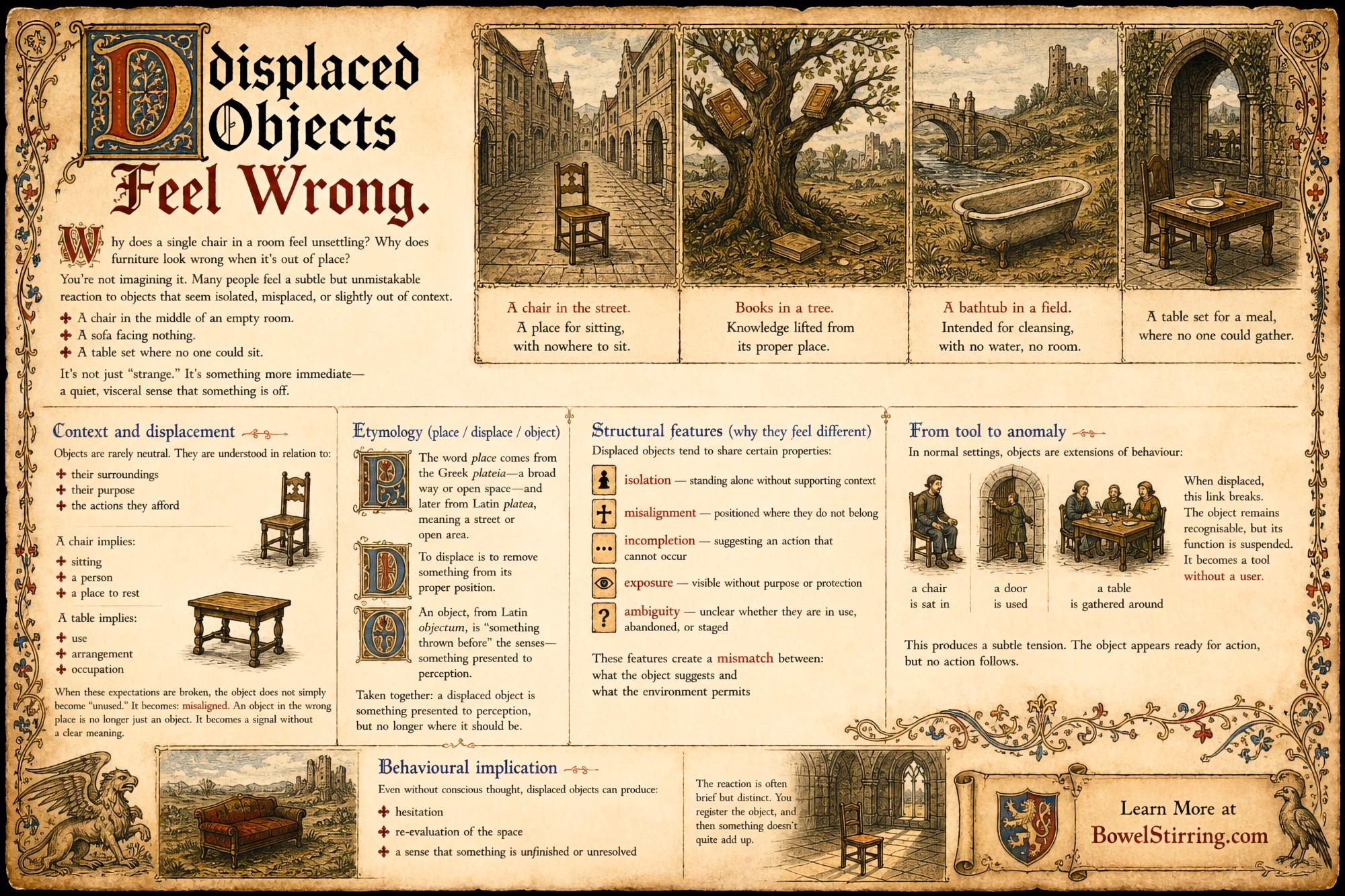
Why does a single chair in a room feel unsettling? Why does furniture look wrong when it’s out of place?
You’re not imagining it. Many people feel a subtle but unmistakable reaction to objects that seem isolated, misplaced, or slightly out of context.
A chair in the middle of an empty room. A sofa facing nothing. A table set where no one could sit.
It’s not just “strange.” It’s something more immediate— a quiet, visceral sense that something is off.
Objects are rarely neutral. They are understood in relation to:
their surroundings
their purpose
the actions they afford
A chair implies:
sitting
a person
a place to rest
A table implies:
use
arrangement
occupation
When these expectations are broken, the object does not simply become “unused.” It becomes: misaligned. An object in the wrong place is no longer just an object. It becomes a signal without a clear meaning.
The word place comes from the Greek plateia—a broad way or open space—and later from Latin platea, meaning a street or open area.
To displace is to remove something from its proper position.
An object, from Latin objectum, is “something thrown before” the senses—something presented to perception.
Taken together: a displaced object is something presented to perception, but no longer where it should be.
Displaced objects tend to share certain properties:
isolation — standing alone without supporting context
misalignment — positioned where they do not belong
incompletion — suggesting an action that cannot occur
exposure — visible without purpose or protection
ambiguity — unclear whether they are in use, abandoned, or staged
These features create a mismatch between:
what the object suggests and
what the environment permits
In normal settings, objects are extensions of behaviour:
a chair is sat in
a door is used
a table is gathered around
When displaced, this link breaks. The object remains recognisable, but its function is suspended. It becomes a tool without a user. This produces a subtle tension. The object appears ready for action, but no action follows.
Even without conscious thought, displaced objects can produce:
hesitation
re-evaluation of the space
a sense that something is unfinished or unresolved
The reaction is often brief but distinct. You register the object, and then something doesn’t quite add up. The object is not threatening. But it is not at rest either.
Displaced objects suggests that an agent has moved them. When that displacement is unusual, it suggests that an unusual agent has meddled. This fires our Predator Geometry detector, leading to a bowel stirring response.
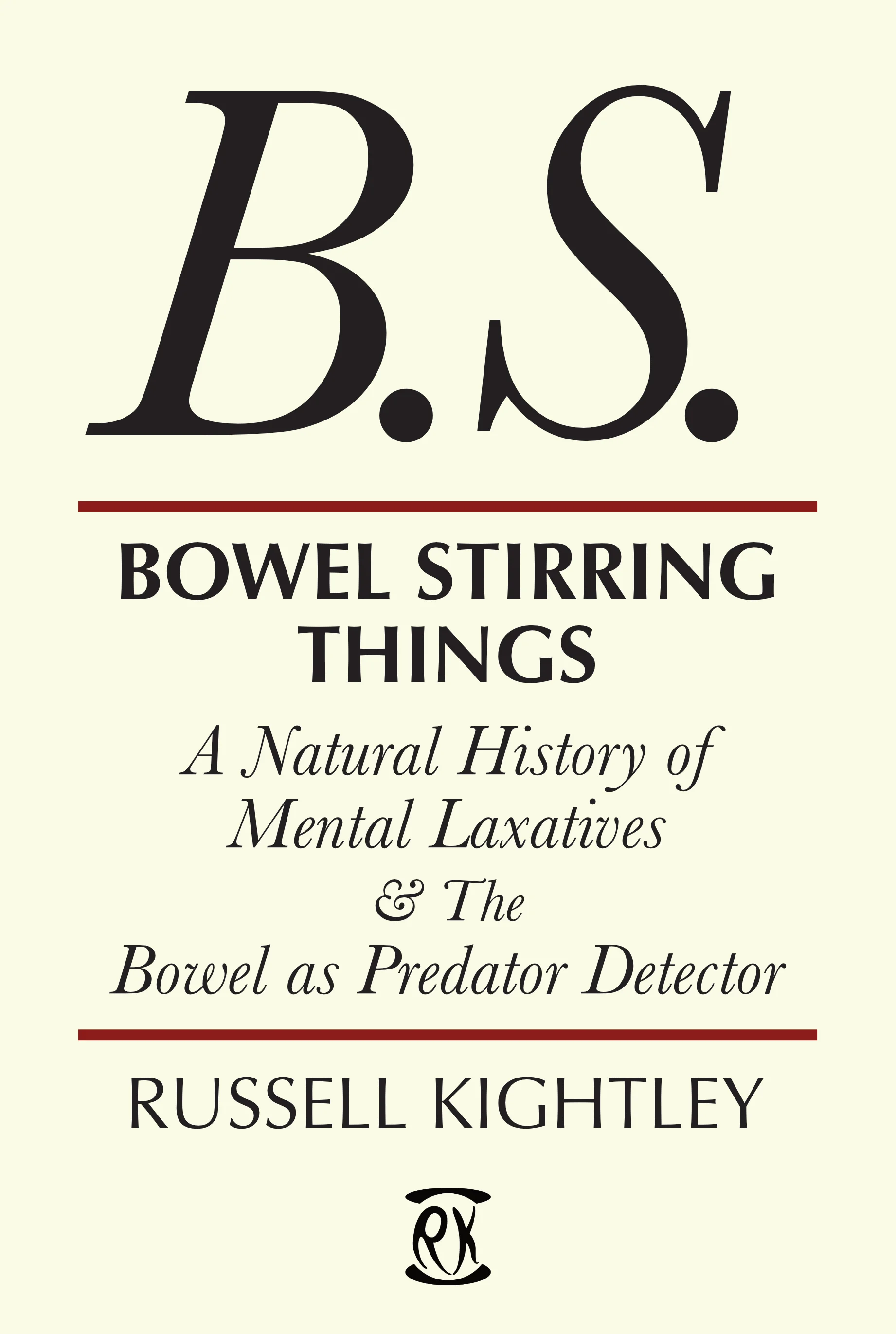
In 1996, Russell Kightley completed a manuscript on what he called “bowel stirring things.” It remained unpublished for thirty years.
In 2026, he revived and refined it as Bowel Stirring Things: A Natural History of Mental Laxatives & The Bowel as Predator Detector—a study of unsettling places and the geometries that provoke an immediate, visceral response.