Success message
Error message
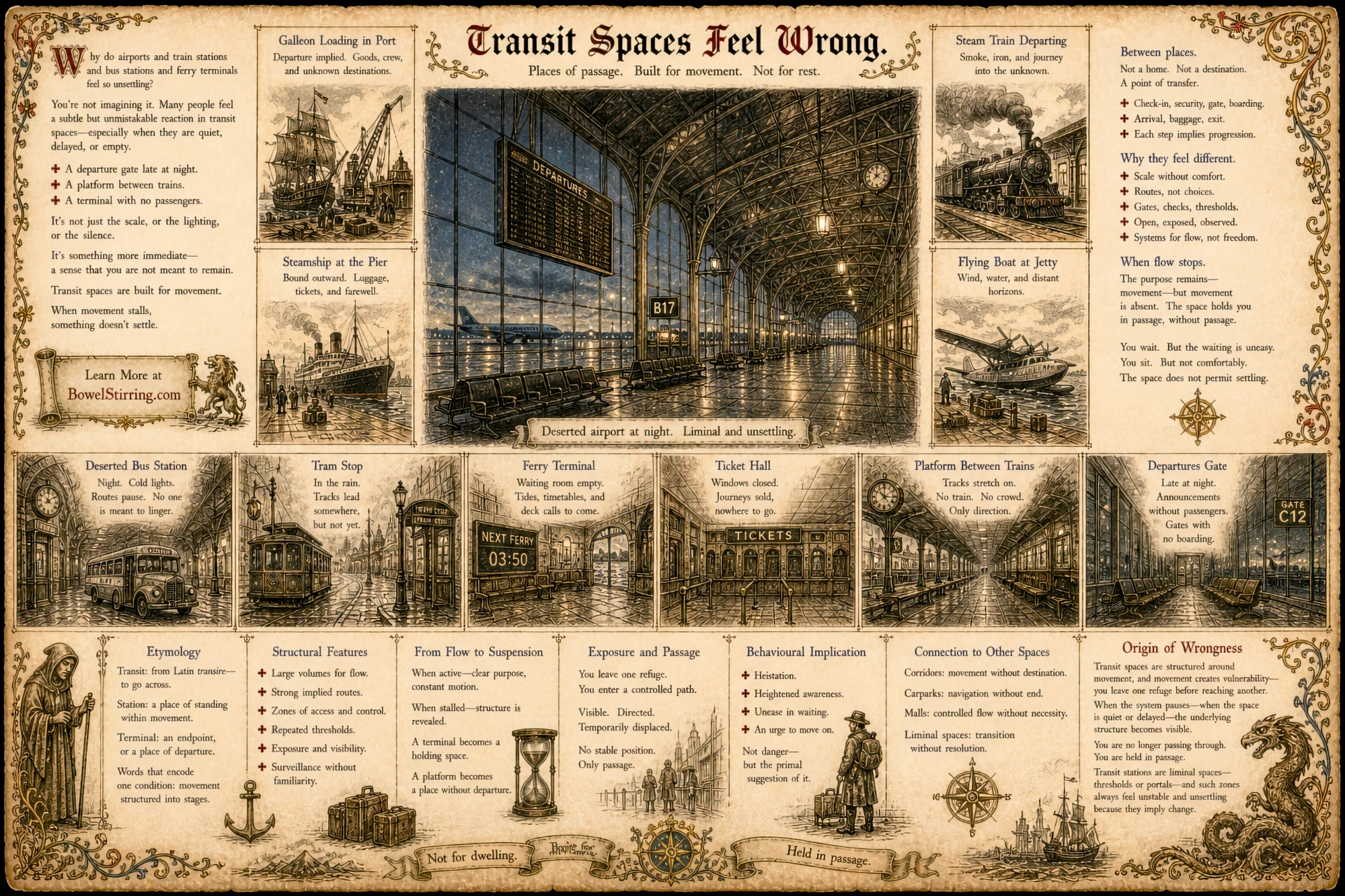
Why do airports and train stations and bus stations and ferry terminals feel so unsettling?
You’re not imagining it. Many people feel a subtle but unmistakable reaction in airports and other transit spaces—especially when they are quiet, delayed, or empty.
A departure gate late at night. A platform between trains. A terminal with no passengers.
It’s not just the scale, or the lighting, or the silence. It’s something more immediate—a sense that you are not meant to remain. Transit spaces are built for movement. When movement stalls, something doesn’t settle.
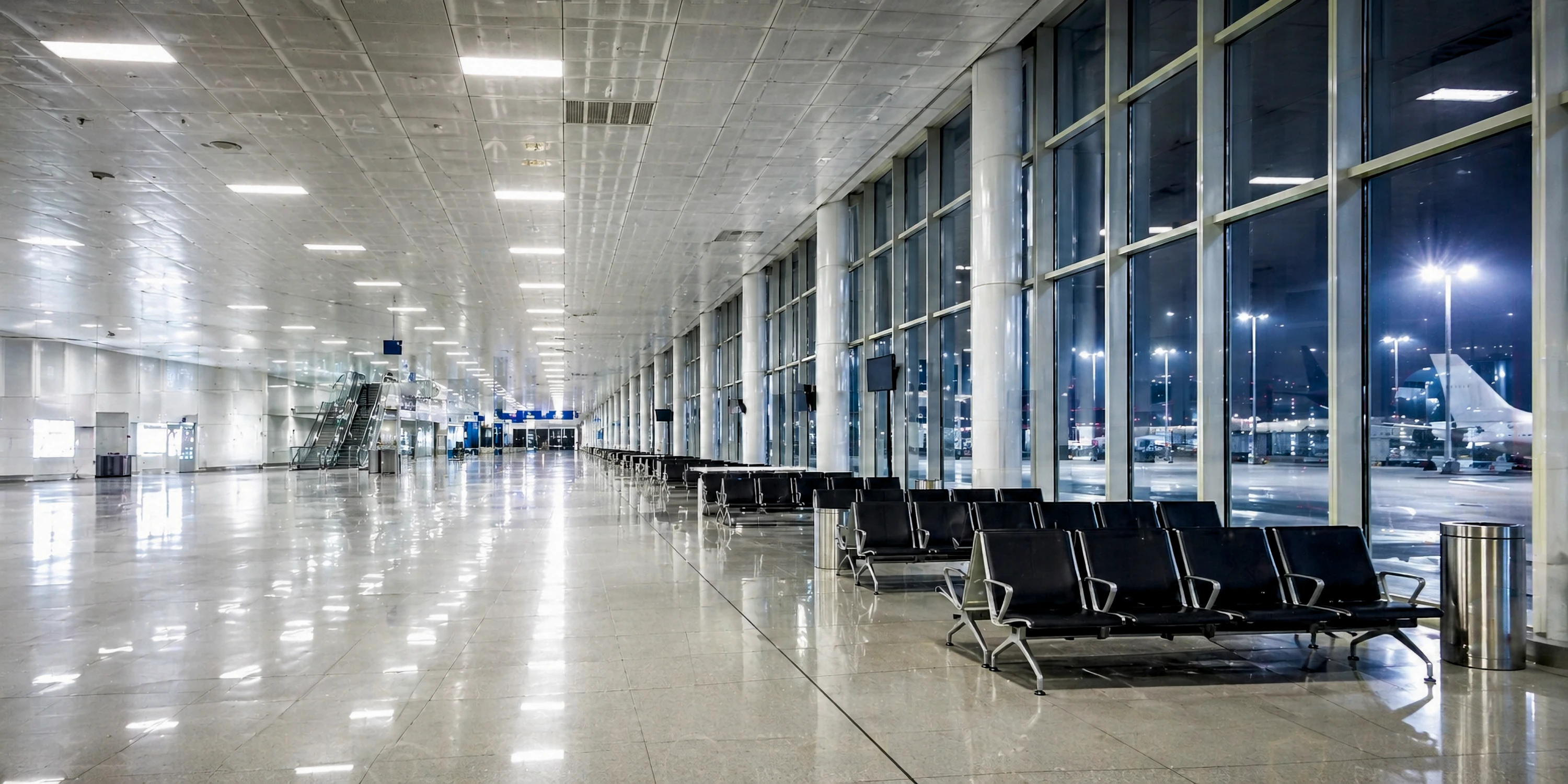
Transit environments connect one city to another, one journey to the next, or one state of being to what follows. They are not destinations. They are points of transfer.
An airport is not a place you inhabit. A station is not a place you stay.
They exist to move bodies through controlled pathways, often quickly, often under constraint.
Check-in, security, gate, boarding. Arrival, baggage, exit.
Each step implies progression.
Transit comes from the Latin transire—to go across. A station is a place of standing—but in practice, it is a place of temporary pause within movement. Terminal carries a double meaning: an endpoint, or a place of departure. These words encode the same condition: movement structured into stages, with brief interruptions.
Transit spaces tend to share certain properties:
scale — large volumes designed for flow, not comfort directionality — strong implied routes and sequences segmentation — zones of access, control, and restriction threshold density — repeated gates, checkpoints, and transitions exposure — open areas with limited refuge surveillance — visibility without familiarity
These are not neutral features. They organise movement, and in doing so, they reduce autonomy.
In normal use, transit spaces are filled with motion. Passengers move, queues form, announcements guide behaviour. The system is active, and its purpose is clear. But when movement stops—when a delay occurs, or the space empties—the structure is revealed. You are left in a system designed for flow, without flow. A terminal becomes a holding space. A platform becomes a place without departure. This produces a subtle tension, for the space implies transition, but no transition is taking place.
Transit spaces sit between refuges. You leave one protected environment—home, hotel, street—and enter a controlled pathway that leads to another. In these pathways, you are visible, directed, and temporarily displaced. There is no stable position. Only passage. When the system is active, this exposure is brief and goes unnoticed. When it stalls, the condition becomes visible. You are in a place that offers movement without resolution.
Even without conscious thought, transit spaces can produce hesitation and a heightened awareness of surroundings. And an urge to move on rather than remain. The reaction is often slight, but persistent.
You wait, but the waiting is uneasy. You sit, but not comfortably.
The space does not permit settling.
Transit environments overlap with other forms of spatial unease:
corridors → directed movement without destination carparks → navigation without clear endpoint malls → controlled flow without necessity liminal spaces → transition without resolution
Each expresses a different version of the same underlying condition.
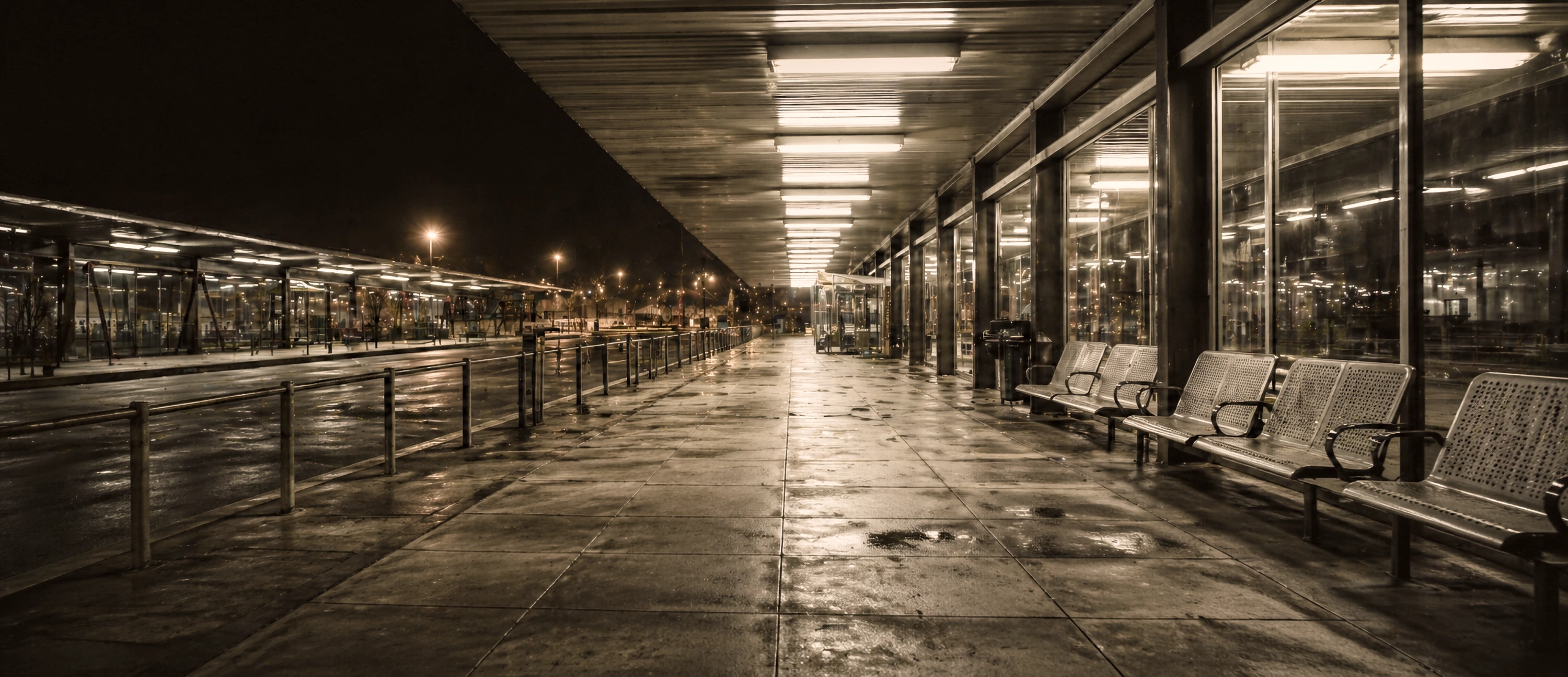
Transit spaces are structured around movement, and movement creates vulnerability—you leave one refuge before reaching another. Airports and stations formalise this condition. They extend it, organise it, and expose it. In normal use, this exposure is masked by activity. But when the system pauses—when the space is quiet or delayed—the underlying structure becomes visible. The human tide goes out.
You are no longer passing through. You are held in passage. This is the source of the unease. Not real danger, but the primal suggestion of it. Transit stations are liminal spaces—thresholds or portals—and such zones always feel unstable and unsettling because they imply change.
In 1996, Russell Kightley completed a manuscript on what he called “bowel stirring things.” It remained unpublished for thirty years.
In 2026, he revived and refined it as Bowel Stirring Things: A Natural History of Mental Laxatives & The Bowel as Predator Detector—a study of unsettling places and the geometries that provoke an immediate, visceral response.