Success message
Error message
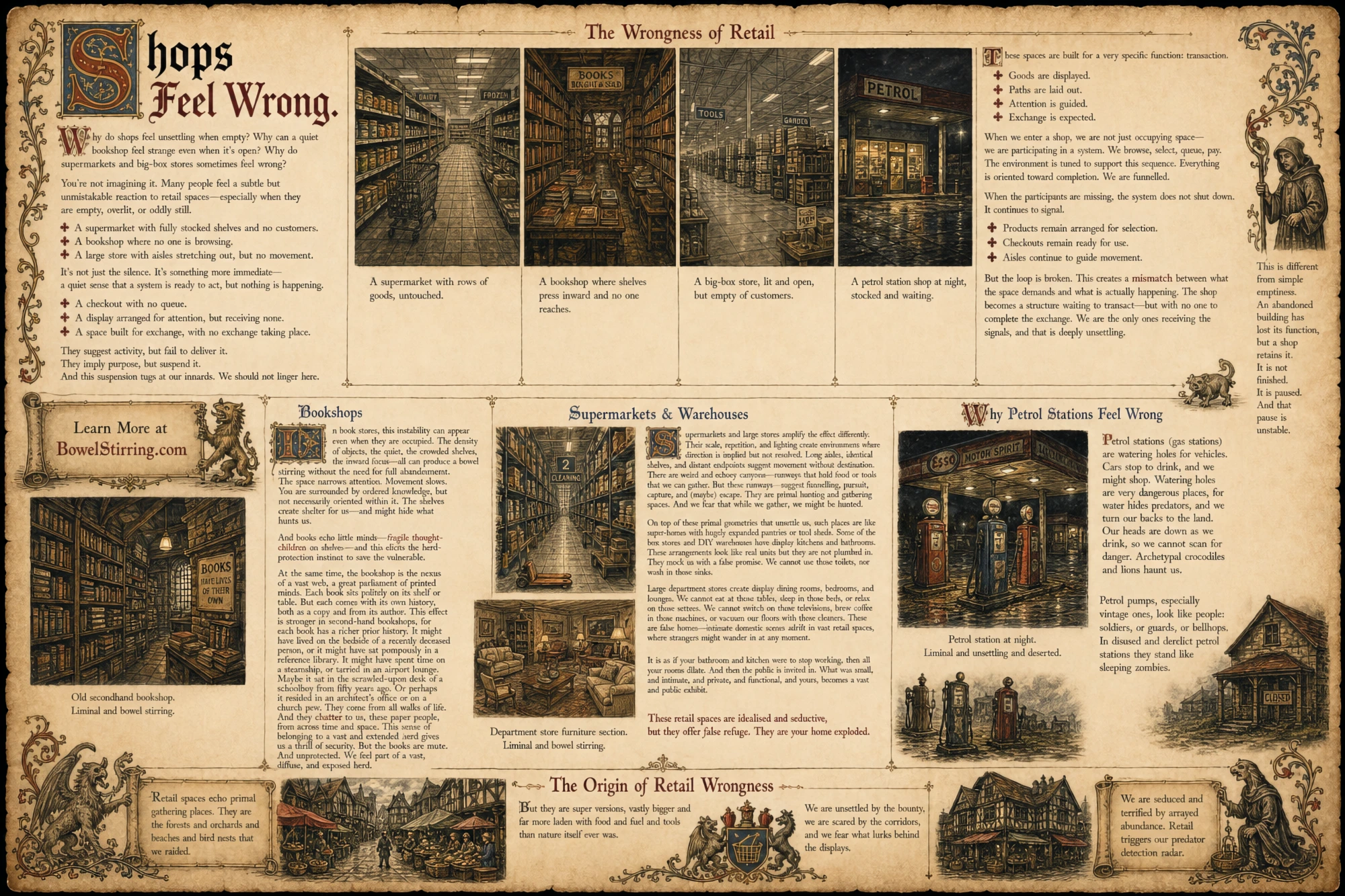
Why do shops feel unsettling when empty? Why can a quiet bookshop feel strange even when it’s open? Why do supermarkets and big-box stores sometimes feel wrong?
You’re not imagining it. Many people feel a subtle but unmistakable reaction to retail spaces—especially when they are empty, overlit, or oddly still.
A supermarket with fully stocked shelves and no customers. A bookshop where no one is browsing. A large store with aisles stretching out, but no movement.
It’s not just the silence. It’s something more immediate— a quiet sense that a system is ready to act, but nothing is happening.
A checkout with no queue. A display arranged for attention, but receiving none. A space built for exchange, with no exchange taking place.
They suggest activity, but fail to deliver it. They imply purpose, but suspend it.
And this suspension tugs at our innards. We should not linger here.
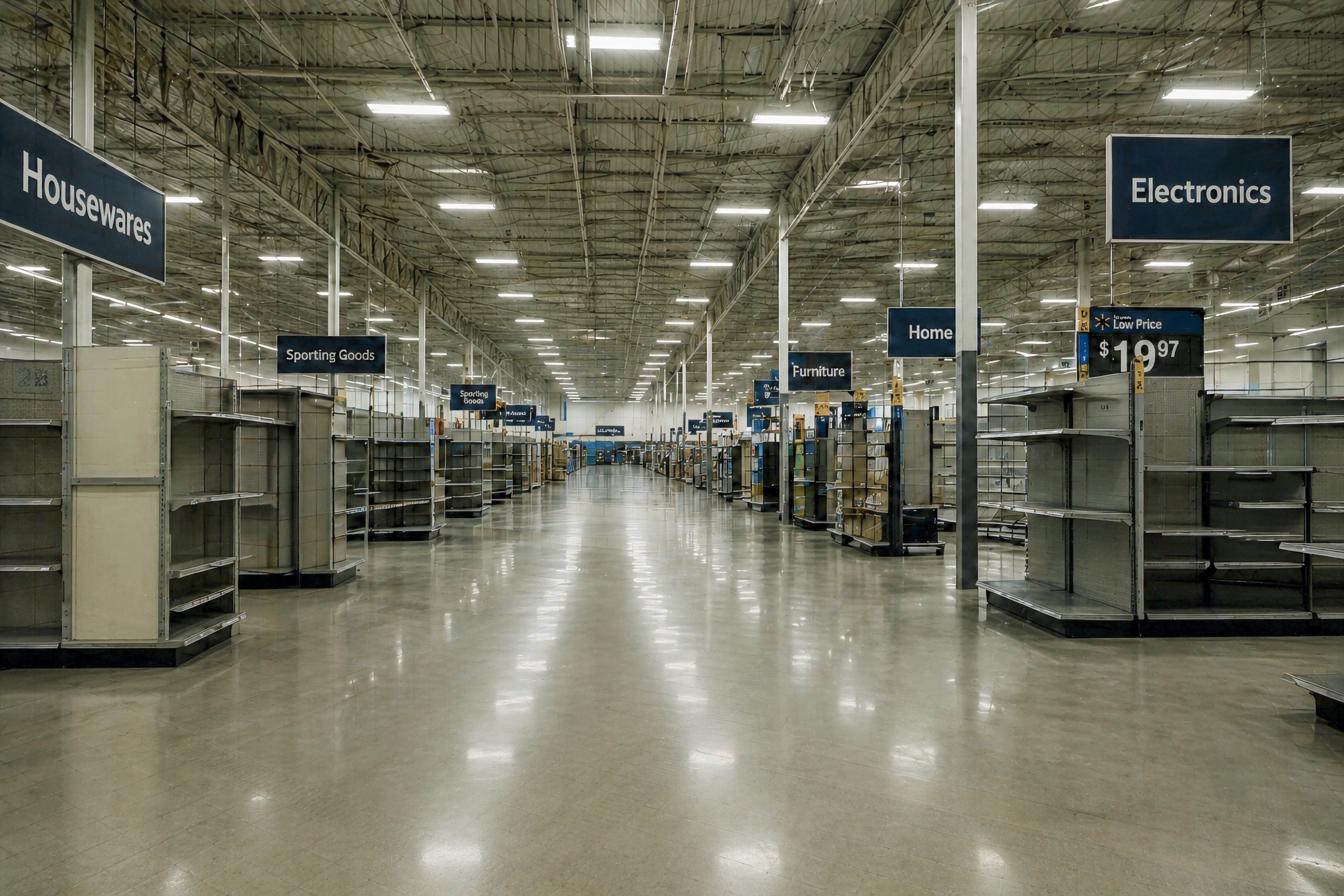
A supermarket with rows of goods, untouched. A bookshop where shelves press inward and no one reaches. A big-box store, lit and open, but empty of customers. A petrol station shop at night, stocked and waiting.
These spaces are built for a very specific function: transaction.
Goods are displayed. Paths are laid out. Attention is guided. Exchange is expected.
When we enter a shop, we are not just occupying space—we are participating in a system. We browse, select, queue, pay. The environment is tuned to support this sequence. Everything is oriented toward completion. We are funnelled.
When the participants are missing, the system does not shut down. It continues to signal.
Products remain arranged for selection. Checkouts remain ready for use. Aisles continue to guide movement.
But the loop is broken. This creates a mismatch between what the space demands and what is actually happening. The shop becomes a structure waiting to transact—but with no one to complete the exchange. We are the only ones receiving the signals, and that is deeply unsettling. This is different from simple emptiness. An abandoned building has lost its function, but a shop retains it. It is not finished. It is paused. And that pause is unstable.
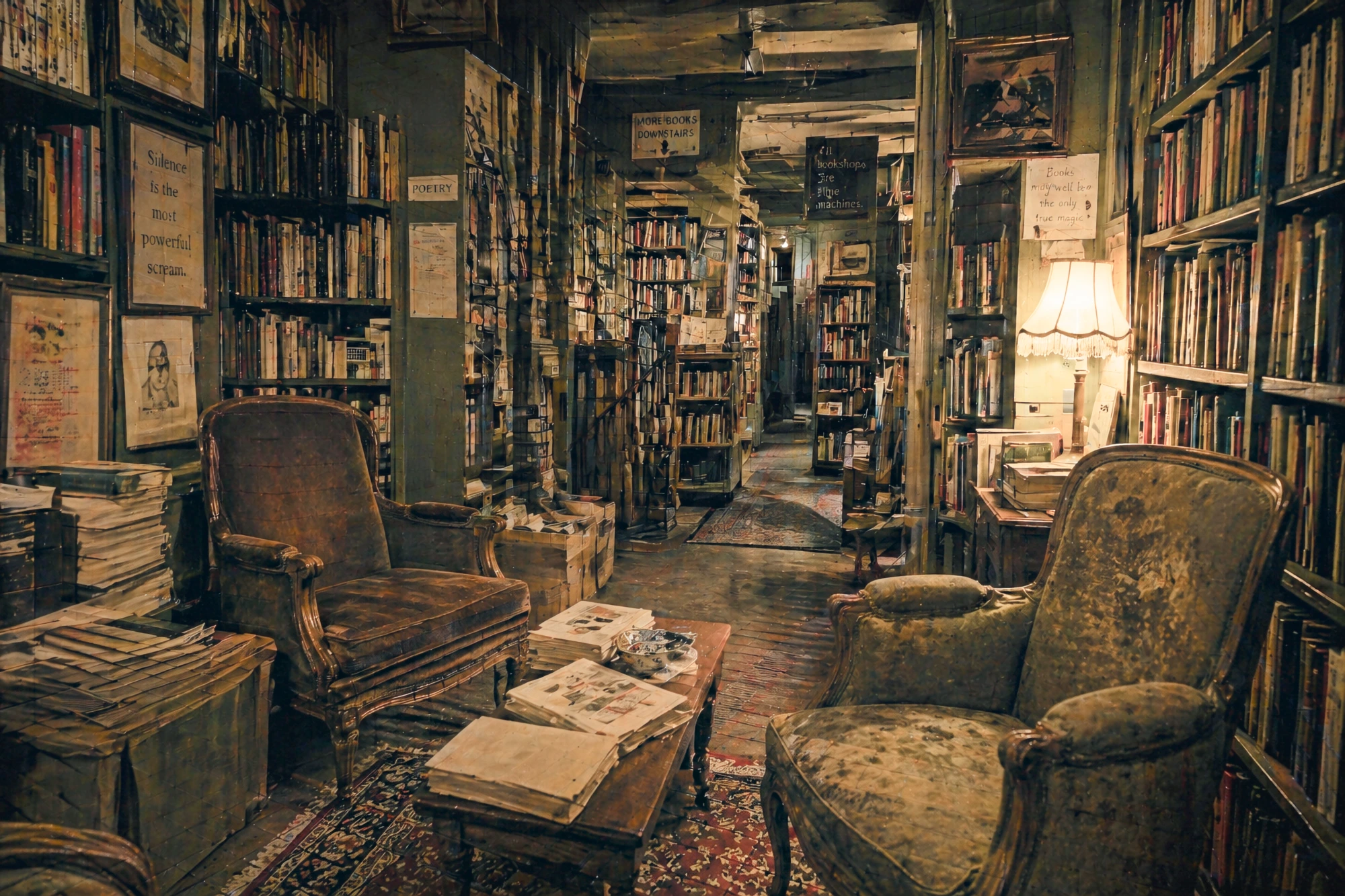
In book stores, this instability can appear even when they are occupied. The density of objects, the quiet, the crowded shelves, the inward focus—all can produce a bowel stirring without the need for full abandonment. The space narrows attention. Movement slows. You are surrounded by ordered knowledge, but not necessarily oriented within it. The shelves create shelter for us—and might hide what hunts us.
And books echo little minds—fragile thought-children on shelves—and this elicits the herd-protection instinct to save the vulnerable.
At the same time, the bookshop is the nexus of a vast web, a great parliament of printed minds. Each book sits politely on its shelf or table. But each comes with its own history, both as a copy and from its author. This effect is stronger in second-hand bookshops, for each book has a richer prior history. It might have lived on the bedside of a recently deceased person, or it might have sat pompously in a reference library. It might have spent time on a steamship, or tarried in an airport lounge. Maybe it sat in the scrawled-upon desk of a schoolboy from fifty years ago. Or perhaps it resided in an architect's office or on a church pew. They come from all walks of life. And they chatter to us, these paper people, from across time and space. This sense of belonging to a vast and extended herd gives us a thrill of security. But the books are mute. And unprotected. We feel part of a vast, diffuse, and exposed herd.
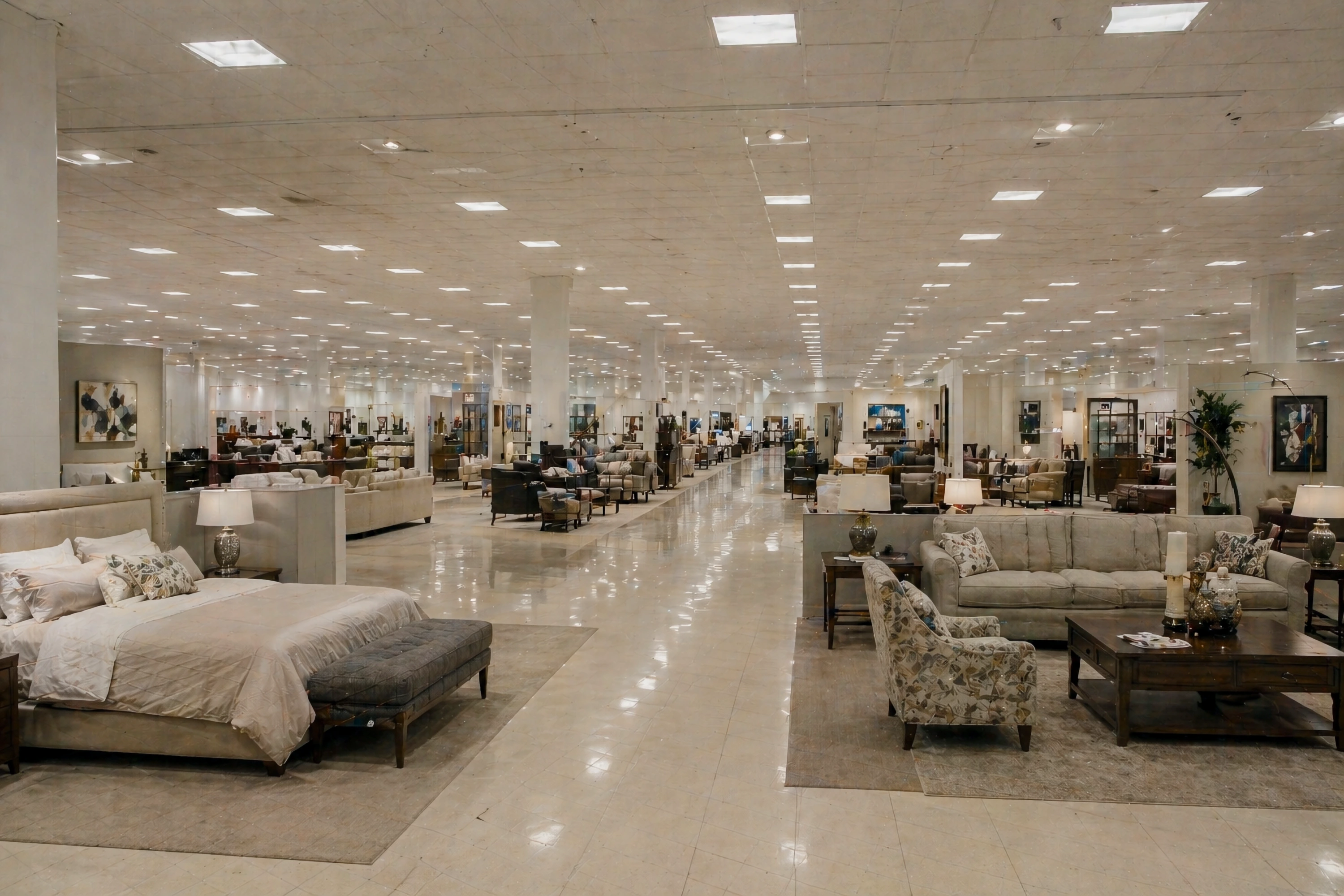
Supermarkets and large stores amplify the effect differently. Their scale, repetition, and lighting create environments where direction is implied but not resolved. Long aisles, identical shelves, and distant endpoints suggest movement without destination. There are weird and echoey canyons—runways that hold food or tools that we can gather. But these runways suggest funnelling, pursuit, capture, and (maybe) escape. They are primal hunting and gathering spaces. And we fear that while we gather, we might be hunted.
On top of these primal geometries that unsettle us, such places are like super-homes with hugely expanded pantries or tool sheds. Some of the box stores and DIY warehouses have display kitchens and bathrooms. These arrangements look like real units but they are not plumbed in. They mock us with a false promise. We cannot use those toilets, nor wash in those sinks.
Large department stores create display dining rooms, bedrooms, and lounges. We cannot eat at those tables, sleep in those beds, or relax on those settees. We cannot switch on those televisions, brew coffee in those machines, or vacuum our floors with those cleaners. These are false homes—intimate domestic scenes adrift in vast retail spaces, where strangers might wander in at any moment.
It is as if your bathroom and kitchen were to stop working, then all your rooms dilate. And then the public is invited in. What was small, and intimate, and private, and functional, and yours, becomes a vast and public exhibit. These retail spaces are idealised and seductive, but they offer false refuge. They are your home exploded.
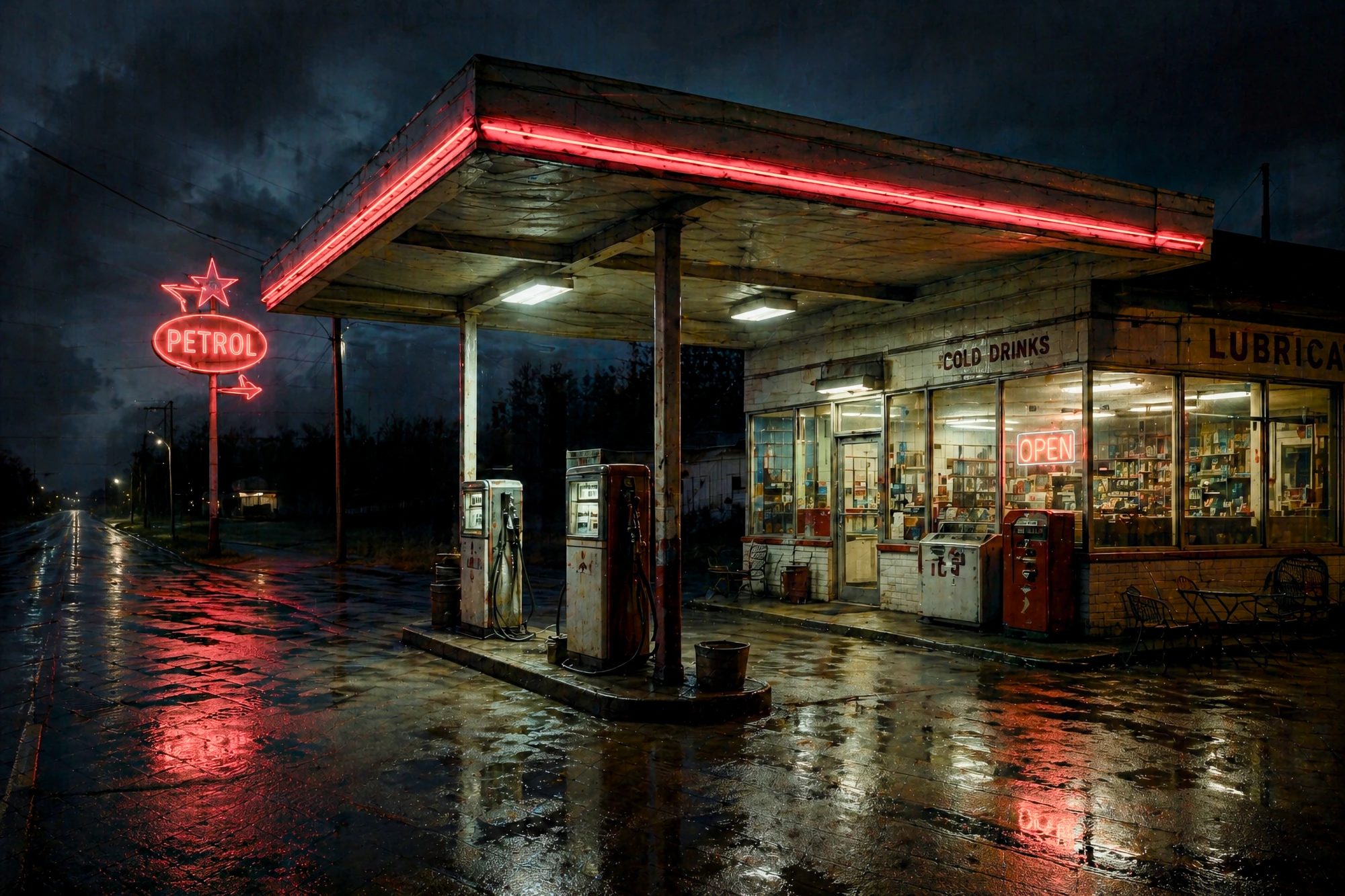
Petrol stations (gas stations) are watering holes for vehicles. Cars stop to drink, and we might shop. Watering holes are very dangerous places, for water hides predators, and we turn our backs to the land. Our heads are down as we drink, so we cannot scan for danger. Archetypal crocodiles and lions haunt us.
Petrol pumps, especially vintage ones, look like people: soldiers, or guards, or bellhops. In disused and derelict petrol stations they stand like sleeping zombies.
Retail spaces echo primal gathering places. They are the forests and orchards and beaches and bird nests that we raided. But they are super versions, vastly bigger and far more laden with food and fuel and tools than nature itself ever was. We are unsettled by the bounty, we are scared by the corridors, and we fear what lurks behind the displays. We are seduced and terrified by arrayed abundance. Retail triggers our predator detection radar.
In 1996, Russell Kightley completed a manuscript on what he called “bowel stirring things.” It remained unpublished for thirty years.
In 2026, he revived and refined it as Bowel Stirring Things: A Natural History of Mental Laxatives & The Bowel as Predator Detector—a study of unsettling places and the geometries that provoke an immediate, visceral response.