Success message
Error message
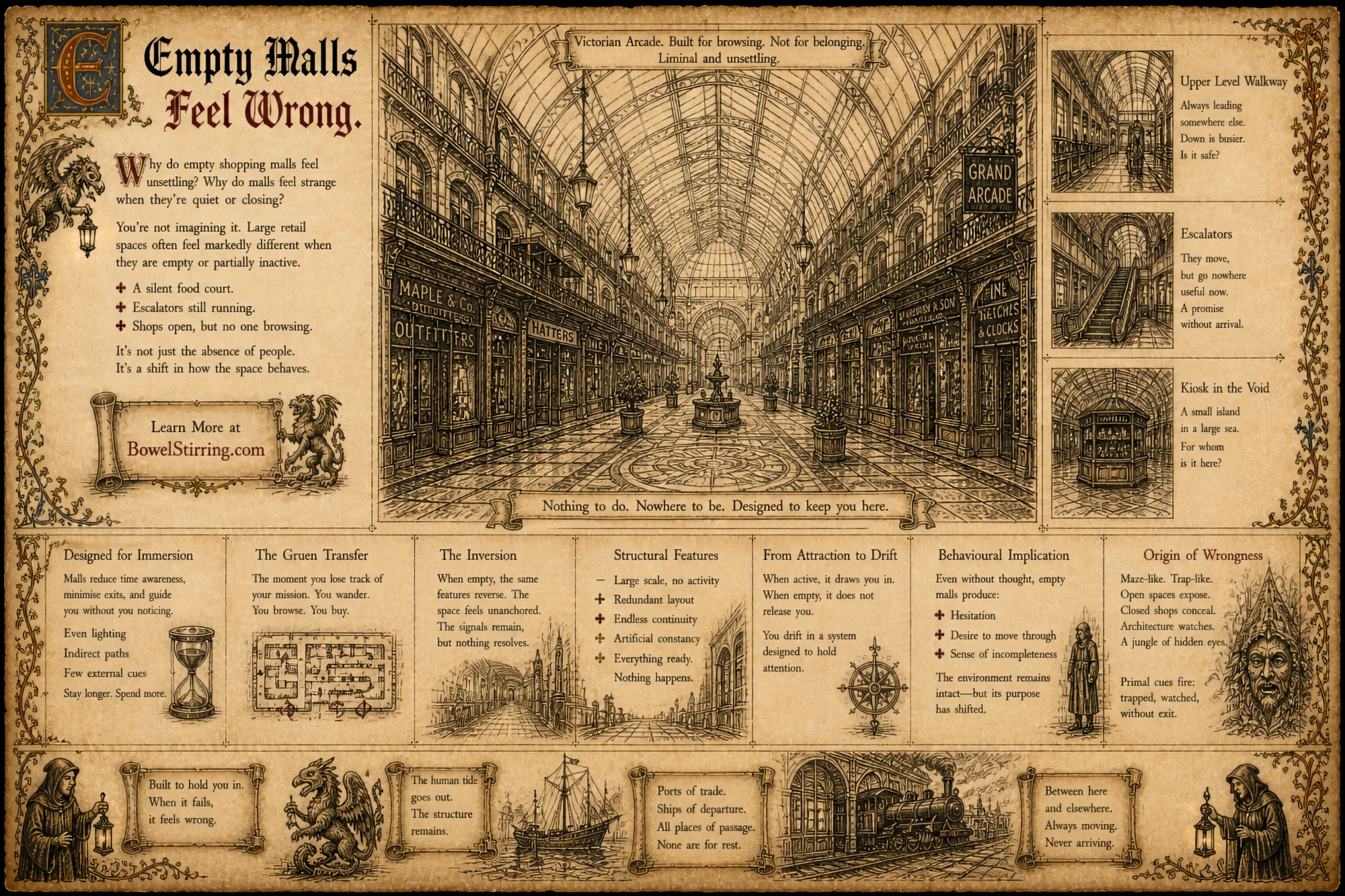
Why do empty shopping malls feel unsettling? Why do malls feel strange when they’re quiet or closing?
You’re not imagining it. Large retail spaces often feel markedly different when they are empty or partially inactive.
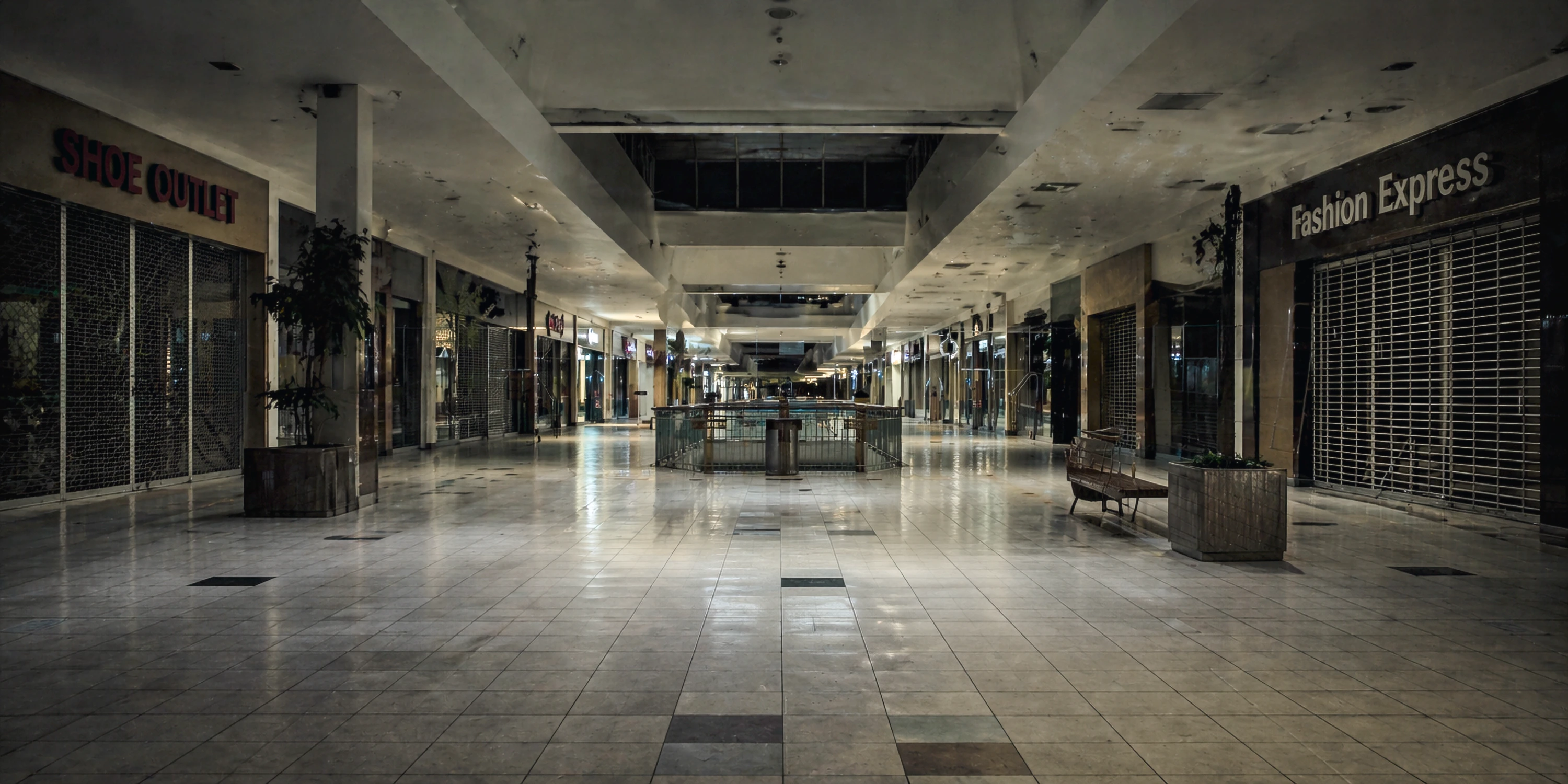
A silent food court. Escalators still running. Shops open, but no one browsing.
It’s not just the absence of people. It’s a shift in how the space behaves.
Modern shopping malls are carefully designed environments. They aim to hold attention, reduce awareness of time, and encourage movement without clear direction. Lighting is even, paths are indirect, and external cues are minimised. The goal is not efficiency, but immersion.
Retail designers sometimes refer to the Gruen transfer. This describes the moment when a shopper loses track of their original intention, becomes disoriented, and is more likely to browse and purchase. It is a controlled form of disorientation. The space encourages you to stay.
When a mall is empty, this effect can reverse. The same features—indirect pathways, uniform lighting, and a lack of external reference—no longer feel immersive. They feel unanchored. Without people, the space loses its social function. The signals remain, but nothing resolves them.
Empty malls often share certain characteristics. Their scale is large, but without activity. Their layout is redundant, offering multiple paths with no clear purpose. The environment has continuity, often appearing endless. Lighting and climate remain artificially stable regardless of use. Everything appears ready, but nothing is happening.
When active, a mall draws you in. When empty, it does not release you in the same way. Instead, the space can feel directionless, suspended, and slightly off. You are still inside a system designed to hold attention, but the usual cues are missing. The mall has become a liminal space.
Even without conscious thought, empty malls can produce hesitation, a desire to move through rather than browse, and a sense that the space is incomplete. The environment remains intact—but its purpose has shifted.
A shopping mall is designed to keep you inside. When it fails to do so, the effect can invert. What was meant to hold attention begins to feel wrong.
The maze-like structure of malls can feel like a trap. The open spaces suggest exposed savannah. The closed shops are lairs. There is a sense of surveillance—of watching eyes—that comes from the architecture itself. Even without security cameras, the mall becomes a nighttime forest of hidden eyes. We respond to the primal cues of jungle geometry.
In 1996, Russell Kightley completed a manuscript on what he called “bowel stirring things.” It remained unpublished for thirty years.
In 2026, he revived and refined it as Bowel Stirring Things: A Natural History of Mental Laxatives & The Bowel as Predator Detector—a study of unsettling places and the geometries that provoke an immediate, visceral response.