Success message
Error message
Why do empty corridors feel wrong?
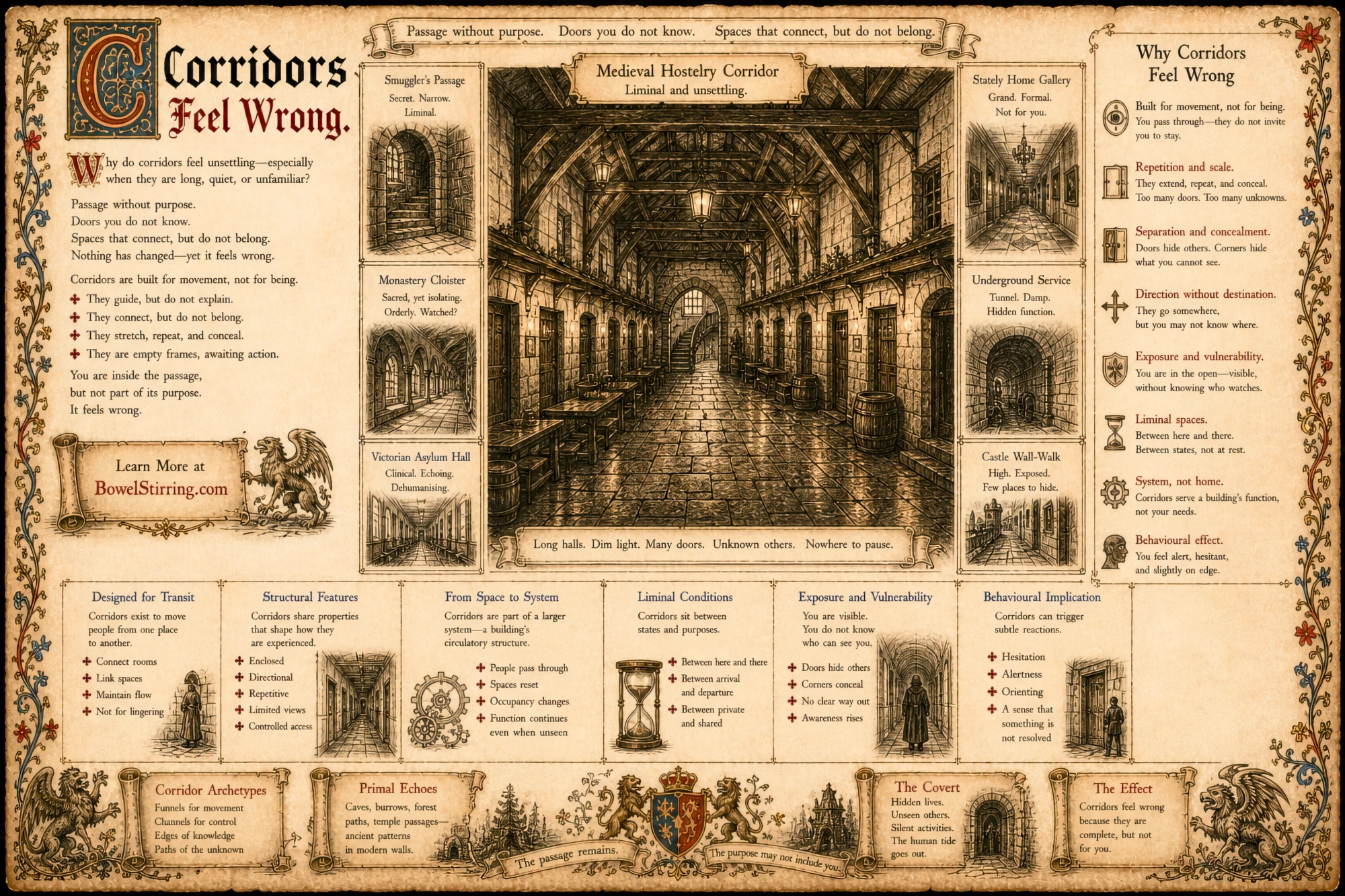
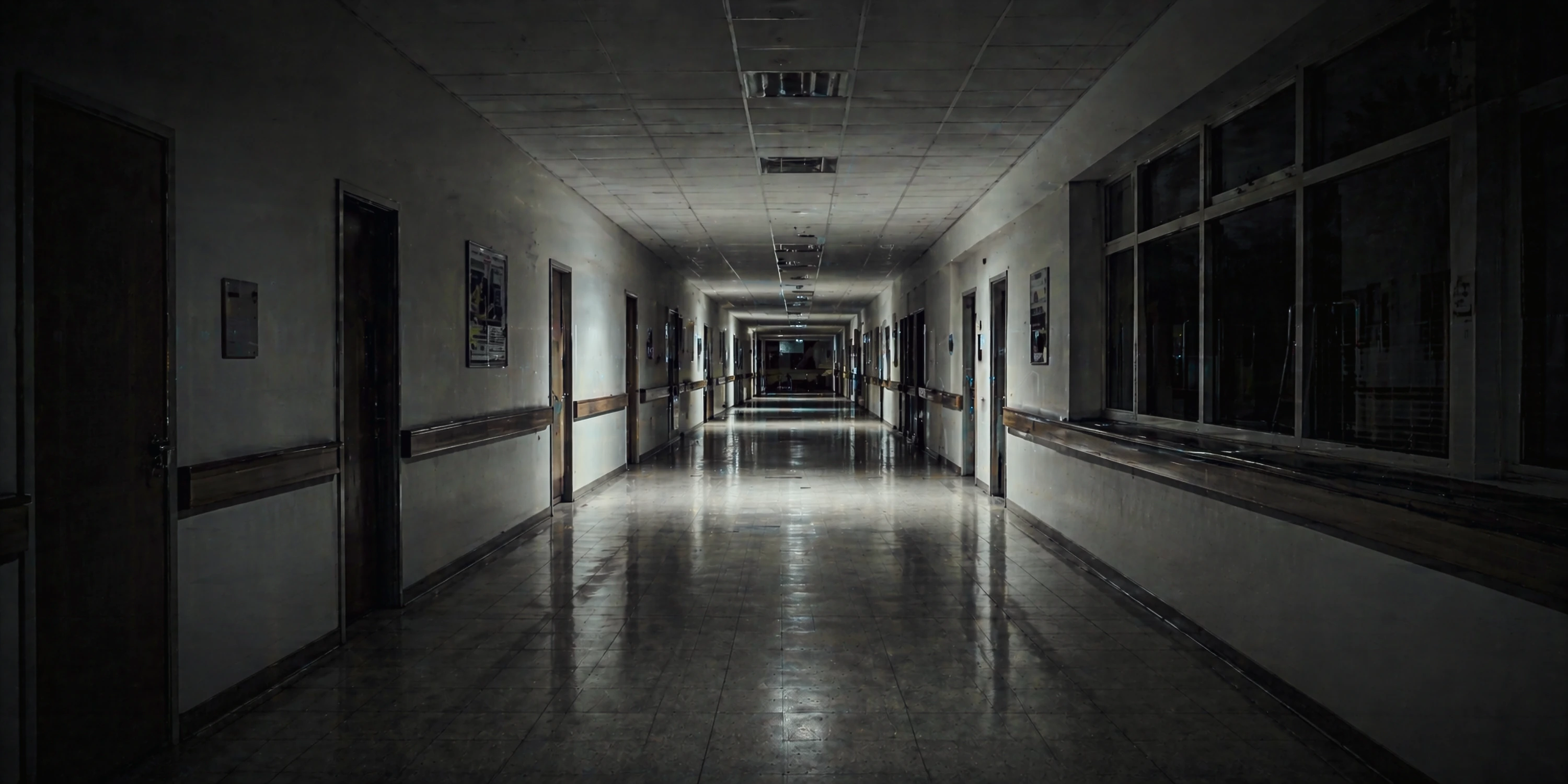
You’re not imagining it. Many people feel a subtle but unmistakable urge to move through or leave certain corridors, especially when they’re empty, narrow, or too long.
It’s not just “creepy.” It’s something more physical—an immediate, hard-to-explain reaction.
The word corridor comes from the Italian corridore, meaning “a runner” or “one who runs,” from correre—to run.
A corridor is—at root—a place for movement.
It is not a place to stop, linger, or dwell. It exists to carry the body from one location to another, often quickly, sometimes under constraint. The word itself encodes motion, urgency, and direction.
Related words reinforce this:
course (a path of movement)
current (that which flows)
courier (one who runs with a message)
All derive from the same root: movement through space. A corridor, then, is not simply a hallway. It is a designed channel of motion—a controlled route through which bodies are expected to pass.
Corridors are a relatively late development in architecture. In medieval buildings, movement between rooms was often direct and exposed. Rooms opened into other rooms. Circulation was visible, social, and often inefficient. The corridor emerges more clearly in early modern and later institutional architecture:
monasteries
barracks
hospitals
schools
large houses
In these settings, corridors serve a new function: to separate movement from occupation. People can move without entering private spaces. Circulation becomes controlled, linear, and often hidden.
By the 18th and 19th centuries, the corridor is standardised as:
long
narrow
directional
often with limited escape points
It becomes a tool of:
efficiency
surveillance
organisation
Corridors tend to share certain properties:
elongation — they extend forward, often beyond immediate visibility
constriction — lateral movement is limited
directionality — they imply a path you are expected to follow
threshold density — doors, openings, or intersections along the way
reduced refuge — few places to stop or withdraw
These features distinguish them from rooms, which are:
wider
more stable
designed for occupation
A room allows you to be. A corridor requires you to go.
Even without conscious thought, corridors tend to produce:
forward movement
increased pace
reduced lingering
When empty, this effect can become more pronounced. Without other people to normalise the space, the corridor is experienced more as a channel without a clear social function. You are in a place designed for movement, but not currently moving through anything. That is why tarrying there feels wrong.
In 1996, Russell Kightley completed a manuscript on what he called “bowel stirring things.” It remained unpublished for thirty years.
In 2026, he revived and refined it as Bowel Stirring Things: A Natural History of Mental Laxatives & The Bowel as Predator Detector—a study of unsettling places and the geometries that provoke an immediate, visceral response.