Success message
Error message
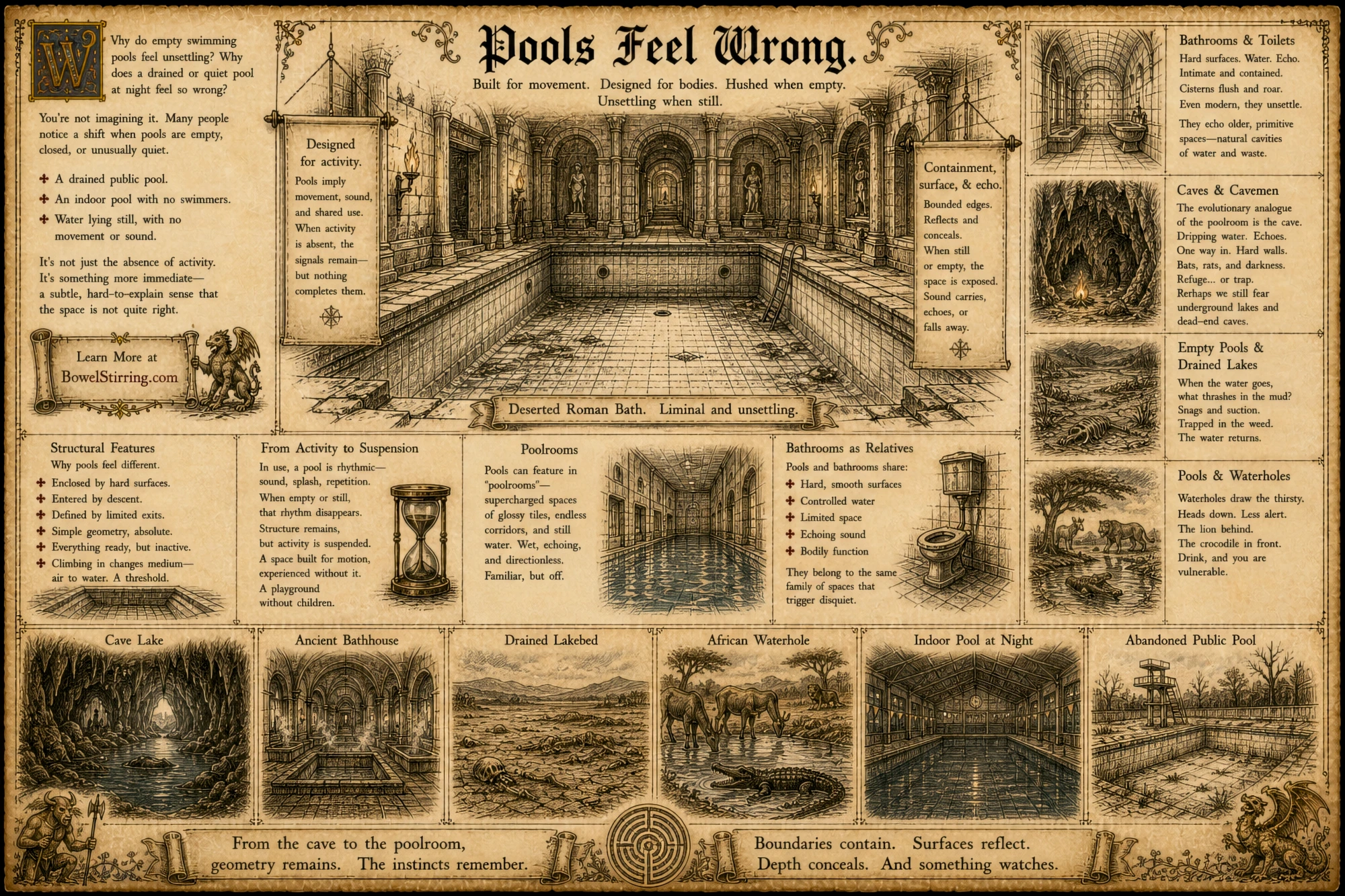
Why do empty swimming pools feel unsettling? Why does a drained or quiet pool at night feel so wrong?
You’re not imagining it. Many people notice a distinct shift in how pools feel when they are empty, closed, or unusually quiet.
A drained public pool. An indoor pool with no swimmers. Water lying still, with no movement or sound.
It’s not just the absence of activity. It’s something more immediate—a subtle, hard-to-explain sense that the space is not quite right.
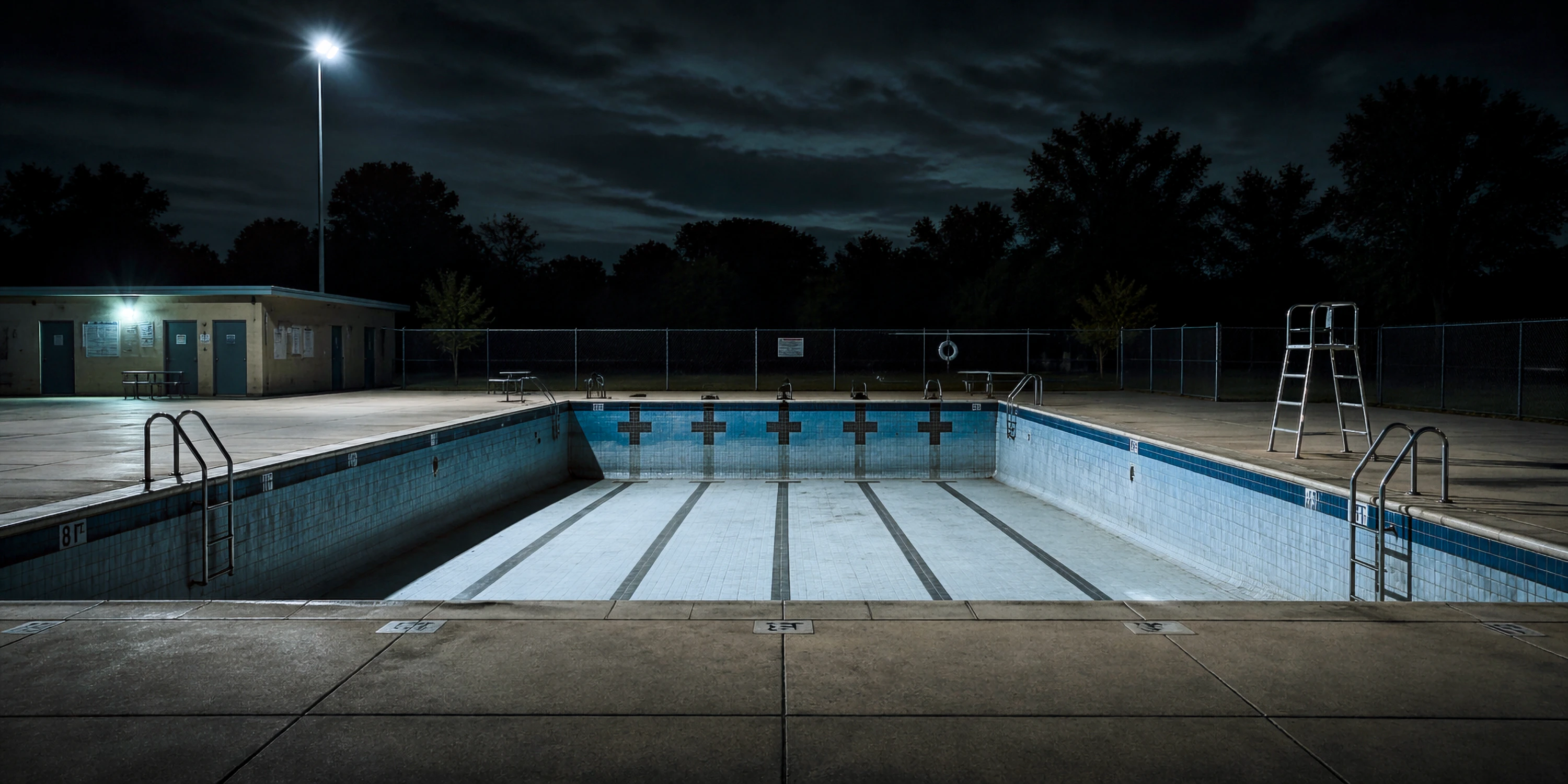
Pools are built for movement. They imply bodies in motion, sound, and shared use. Even when calm, water suggests activity. When that activity is absent, the signals remain—but nothing completes them. The hollow un-sound of the switched-off machine.
A pool is a bounded space with hard edges, a fixed perimeter, and a controlled depth. The water surface reflects and distorts at the same time, suggesting both openness and concealment.
When still—or when the pool is empty—the space becomes exposed. Sound changes. Small noises carry, echo, or fall away. The environment feels contained, but unresolved. Pools can feature in the supercharged fantasy spaces called poolrooms.
Empty or quiet pools share a few key conditions. They are enclosed by hard surfaces, entered by descent, and defined by limited exits. Their geometry is simple but absolute. Everything appears ready, but inactive. This creates a mismatch between what the space suggests and what is happening. Climbing into water means changing medium, which makes pools liminal places (threshold zones where air and water meet).
In use, a pool is rhythmic. Movement repeats, sound fills the space, and the environment feels resolved. When empty or still, that rhythm disappears. The structure remains, but the activity is suspended. The pool becomes a space designed for motion, experienced without it. A playground without children.
Pool discomfiture can overlap with bathroom disquiet. Bathrooms share similar features—hard surfaces, enclosed volume, controlled water, and a focus on bodily function. Sound behaves in comparable ways. Water drips, echoes, and marks the space with small, repeated signals. Cisterns flush and roar. Even when clean and modern, bathrooms remain unsettling. They are intimate, contained, and slightly exposed.
At a deeper level, these conditions resemble older, more primitive environments. Enclosure, hard boundaries, limited exits, and the presence of water are all features found in natural cavities—hollows, chambers, and cave-like spaces.
The evolutionary analogue of the poolroom is the cave, a place of retreat, safety, and shelter. Caves often had dripping water and some had subterranean rivers and lakes. Caves might only have one useable entrance, creating a refuge/trap ambivalence. Sound was distorted and echoey. Light was unreliable. Scuttling rats and sleeping bats might call it home. And the walls were hard and unyielding. And you might get trapped.
Perhaps the modern disquiet triggered by deserted swimming pools and echoey bathrooms is the caveman's fear of underground lakes and dead-end caves.
Drained swimming pools and empty baths might trigger an ancient fear of drained lakes. When the water goes, aquatic predators might thrash about in the tangled weed and mud. The soggy lakebed is a hazardous place where your foot might snag, trapping you while something stalks you, or the water returns.
Swimming pools echo waterholes where animals come to drink. Drinking with their heads down they are less alert to predators from the land, and more vulnerable to predators from below (the lion behind and the crocodile in front).
In 1996, Russell Kightley completed a manuscript on what he called “bowel stirring things.” It remained unpublished for thirty years.
In 2026, he revived and refined it as Bowel Stirring Things: A Natural History of Mental Laxatives & The Bowel as Predator Detector—a study of unsettling places and the geometries that provoke an immediate, visceral response.