Success message
Error message
This webpage is an analysis of the Backrooms lore, written by the author of the book Bowel Stirring Things, which provides the foundational psychological theory for this page. Bowel Stirring Things was written in 1996. Edited and published in early 2026.
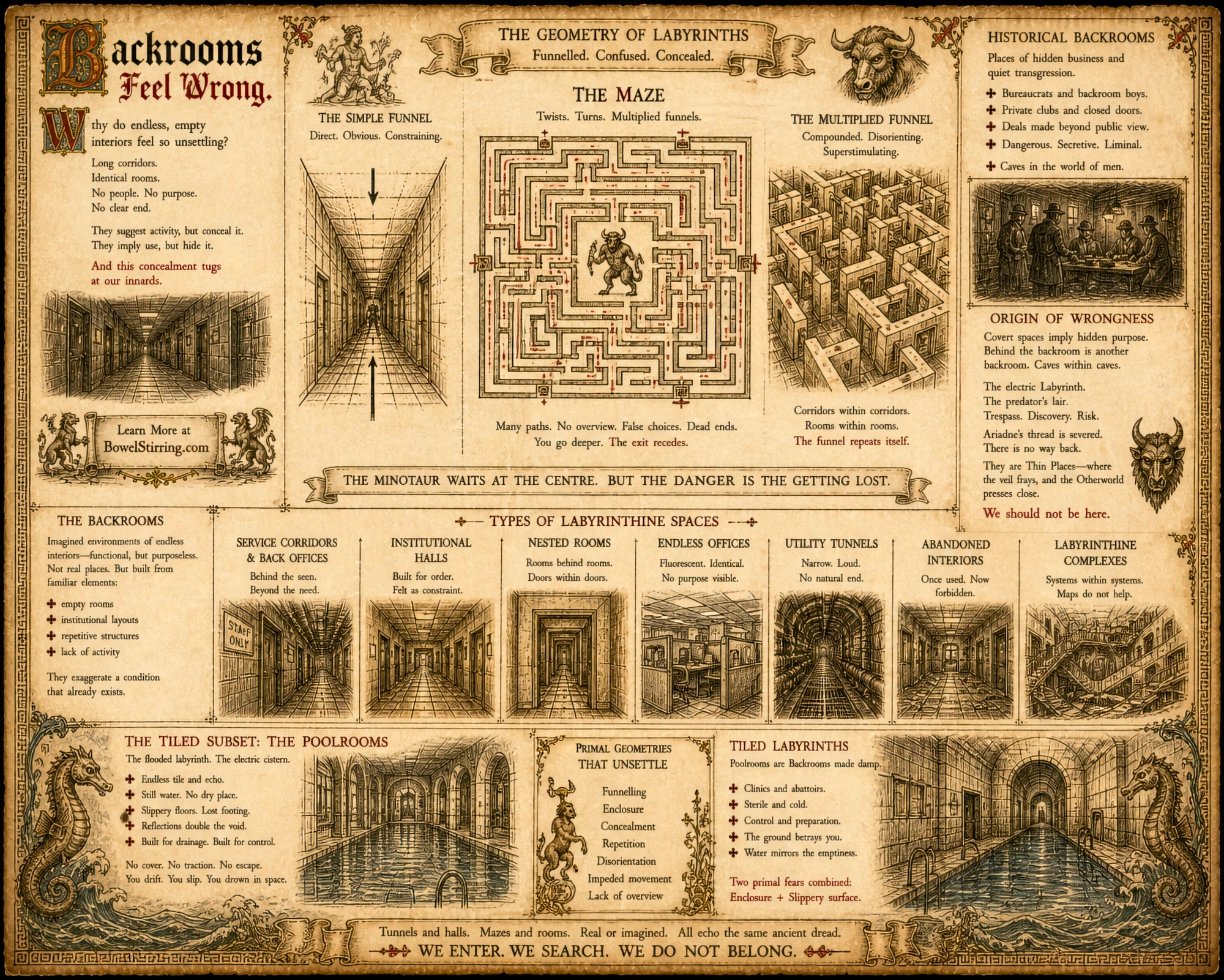
Why do backrooms feel so unsettling? Why do endless, empty interiors and liminal spaces feel wrong? Why do office corridors and hidden rooms provoke that same quiet unease?
You’re not imagining it. Many people feel a subtle but unmistakable reaction to spaces that seem to have no clear end—rooms that repeat, corridors that lead nowhere, interiors that look functional but resolve nothing.
A long office corridor with no people. A series of identical rooms under fluorescent light. A service hallway behind a public space.
It’s not just the aesthetic. It’s something more immediate— a quiet, hard-to-explain sense that the space is not meant to be entered, and certainly not meant to be stayed in.
A maintenance corridor behind a mall. A back office with no clear purpose. A doorway marked “staff only.”
They suggest activity, but conceal it. They imply use, but hide it. And this concealment tugs at our innards.
We should not be here.
This is what my psychological theory calls the Predator Geometry of liminal mazes—an evolutionary spatial architecture that triggers the instinctual survival mechanics detailed in my book, Bowel Stirring Things.
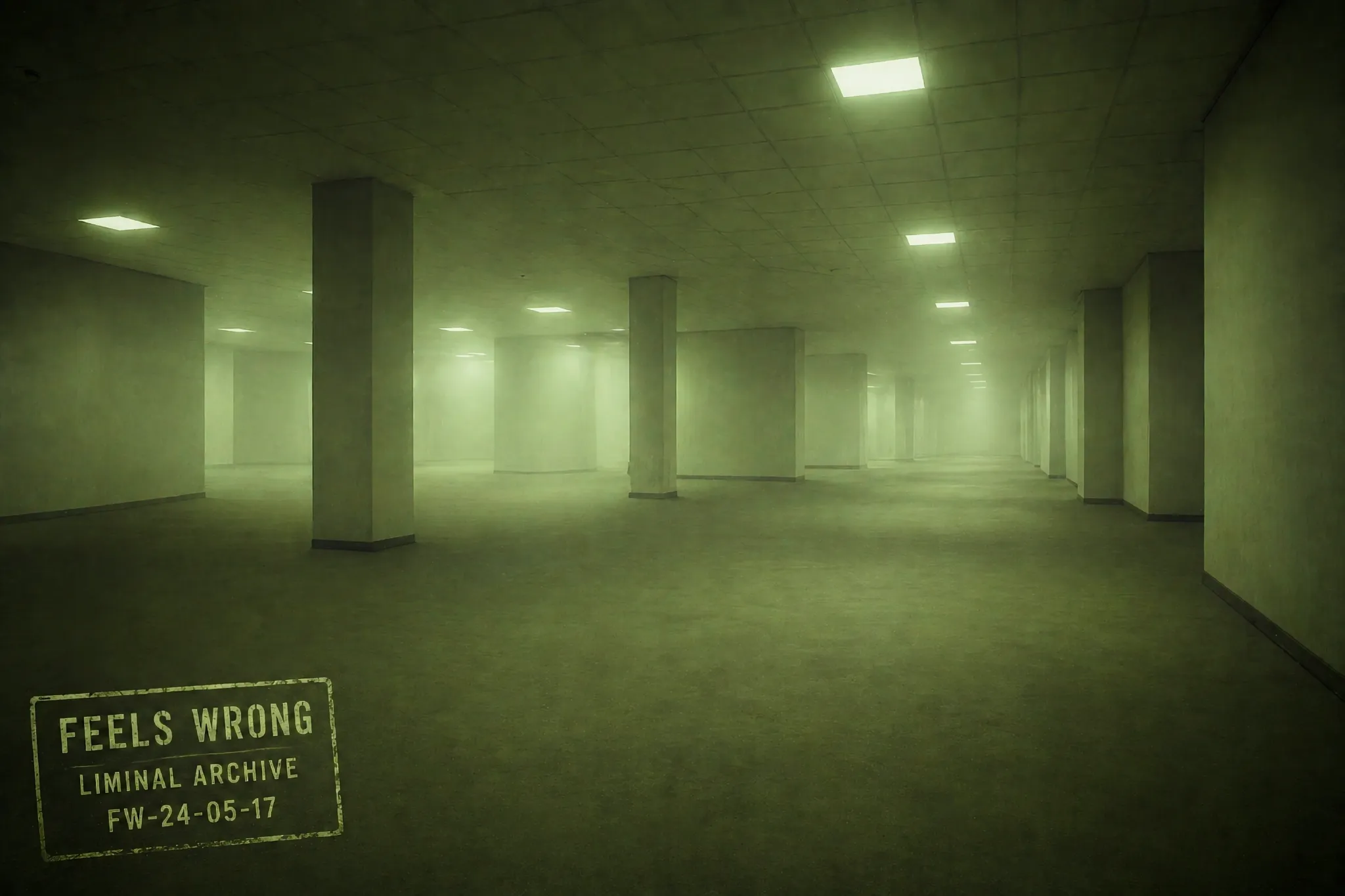
In recent years, internet culture has produced a stylised version of this liminal effect, often referred to as the “Backrooms”.
These imagined environments consist of endless, empty, office-like interiors—corridors, rooms, and spaces that appear functional but serve no clear purpose.
They are not real places. But they are built from familiar elements:
empty rooms, institutional layouts, repetitive structures, and a lack of activity.
They exaggerate a condition that already exists in everyday environments. Backrooms, so-called, are the spatial or architectural equivalents of biological superstimuli.
The Backroom isn't just an imagined empty office—it's the site of invisible history. Whether it’s the 'Backroom Boys' of bureaucracy or the 'Backrooms' of 80s nightlife, these are spaces where the public boundary shimmers. That instability stirs your bowels. Those backrooms were dangerous, transgressive places where codes or connections or shady deals were made. And they were hidden from public view, making them liminal and secretive, like caves.
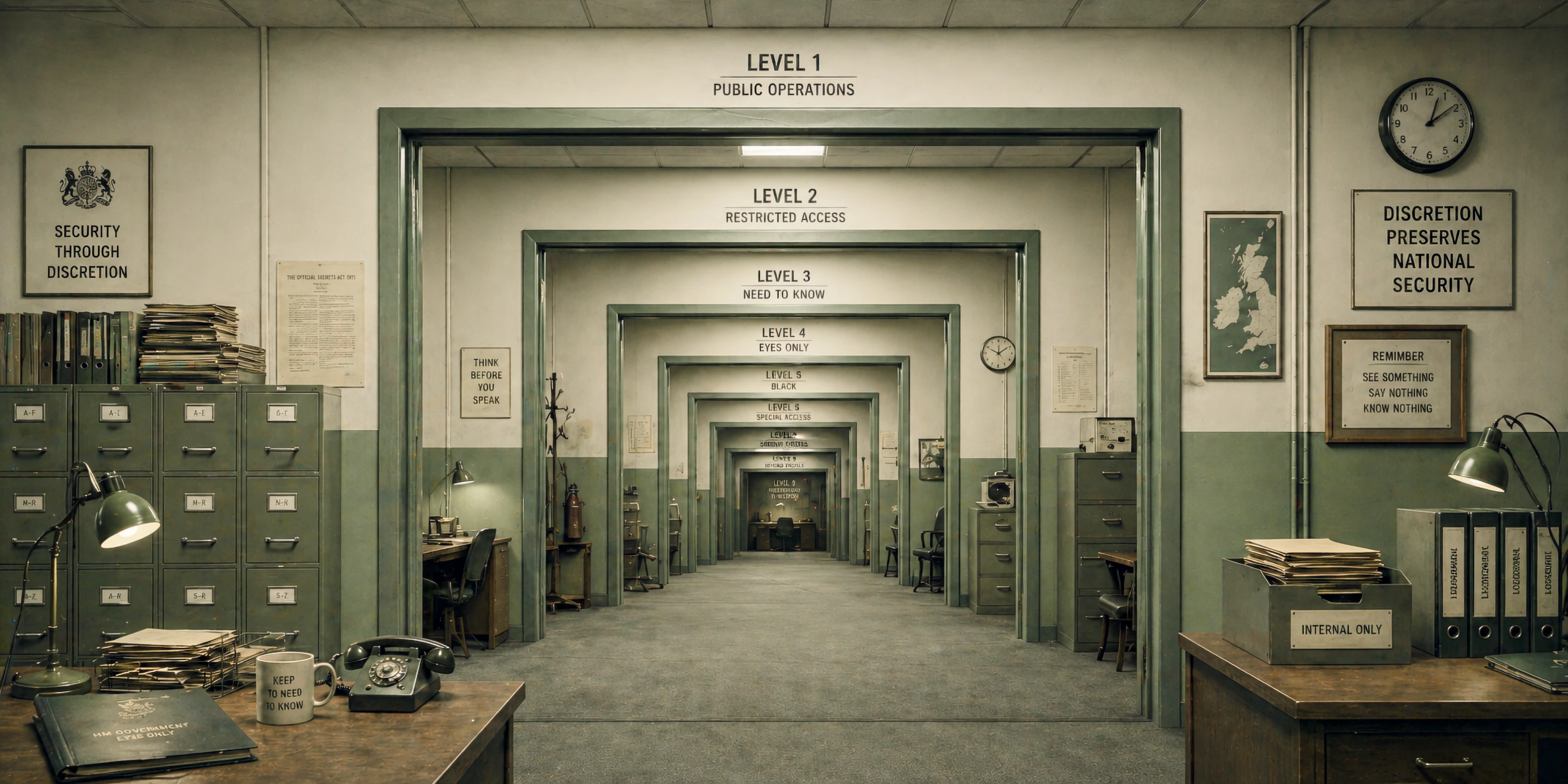
Backrooms are covert, and so we suspect things are going on that might threaten us. They are the caves at the back of the corporate office, or the private zones of clubs. Or the hidden sites of weapons development. If we enter such places we feel that delicious, visceral sense of trespass. We might get caught—and we know too much. They hint at the predator's lair. And there is the potential of regression, that at the back of the backroom is another backroom, a sequence of nested secrets—caves within caves.
Backrooms are the electric version of the Minotaur’s Labyrinth. In the ancient world, the gut tumbled because of the beast in the maze. Today, the bowel stirs because of the hum in the drywall. Both geometries sequester and confuse. And they trigger the ancient Predator Detector inside us. Are we to be sacrificed?
In the ancient Labyrinth, Ariadne's thread was the only thing that made 'back' a reality. Without it, the maze's geometry consumed you. The Backrooms are designed to sever that thread—to make you feel that you cannot go back, and that looking back is futile. In fact they make you think there is no thread.
Backrooms also echo Celtic "Thin Places"—the sidhe mounds where reality loses its density and the barrier to the Otherworld vanishes. They are mythic portals. A "no-clipping" through the veil. Mythology is rich with such boundary sites which act as doorways between worlds.
Daedalic. Dangerous. Deep. Dissonant. Disconnected. Backrooms are the predator's trap. They are repeating and amplified corridors—predator funnels on a grand scale.
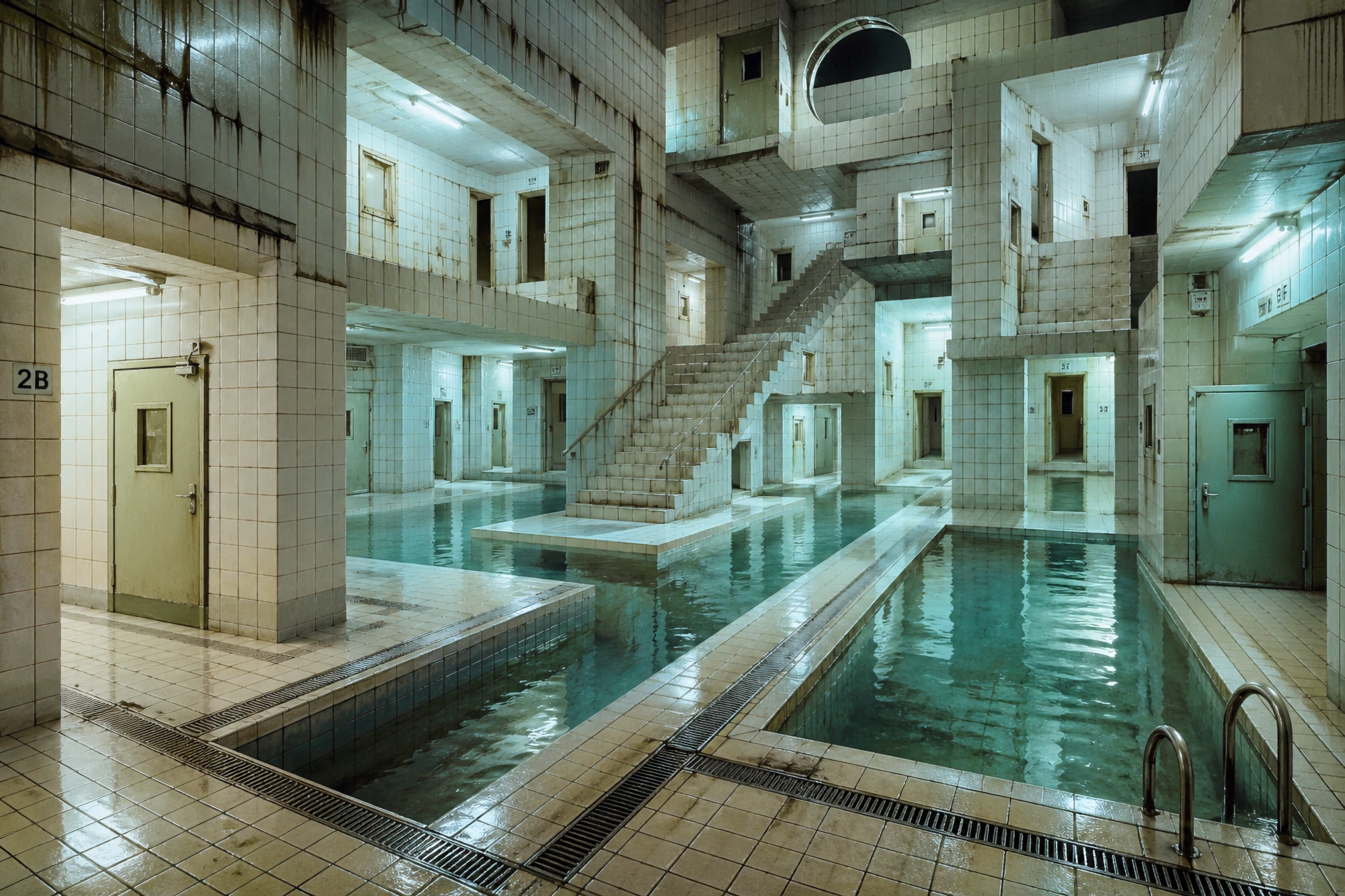
If Backrooms are dry electric labyrinths, Poolrooms are their flooded counterpart—damp, tiled mazes. Poolrooms are fever-dream versions of swimming pools—amplified and extended into:
Endless corridors of glossy ceramic. Still, reflective water. The slap of bare feet. The echo of dripping that never quite stops. Cyan light bouncing coldly off wet surfaces.
They mimic the architecture of the abattoir: tiled, sterile, built for the efficient drainage of fluids. They also recall clinics and laboratories—spaces of control, preparation, and intervention—with hints of sterilization and vivisection.
But the crucial shift is the ground itself. The floor is no longer stable—it's wet, reflective, uncertain. Every step is slowed, softened, compromised. This is not a surface designed for escape. It is a surface that resists movement. The water turns the floor into a mirror. This doubles the emptiness and removes any sense of solid ground. There is no dry place to stand.
Here the predator detector fires on two fronts:
total enclosure and impeded movement
No cover. No traction. No clear path.
Just you, the tiles, the water, and the echo.
This super-stimulating nightmare mixes two primal landscapes: slippery water or ice + funnelling. Both Backrooms and Poolrooms deliver the same message:
We should not be here.
In 1996, Russell Kightley completed a manuscript on what he called “bowel stirring things.” It remained unpublished for thirty years.
In 2026, he revived and refined it as Bowel Stirring Things: A Natural History of Mental Laxatives & The Bowel as Predator Detector—a study of unsettling places and the geometries that provoke an immediate, visceral response.