Success message
Error message
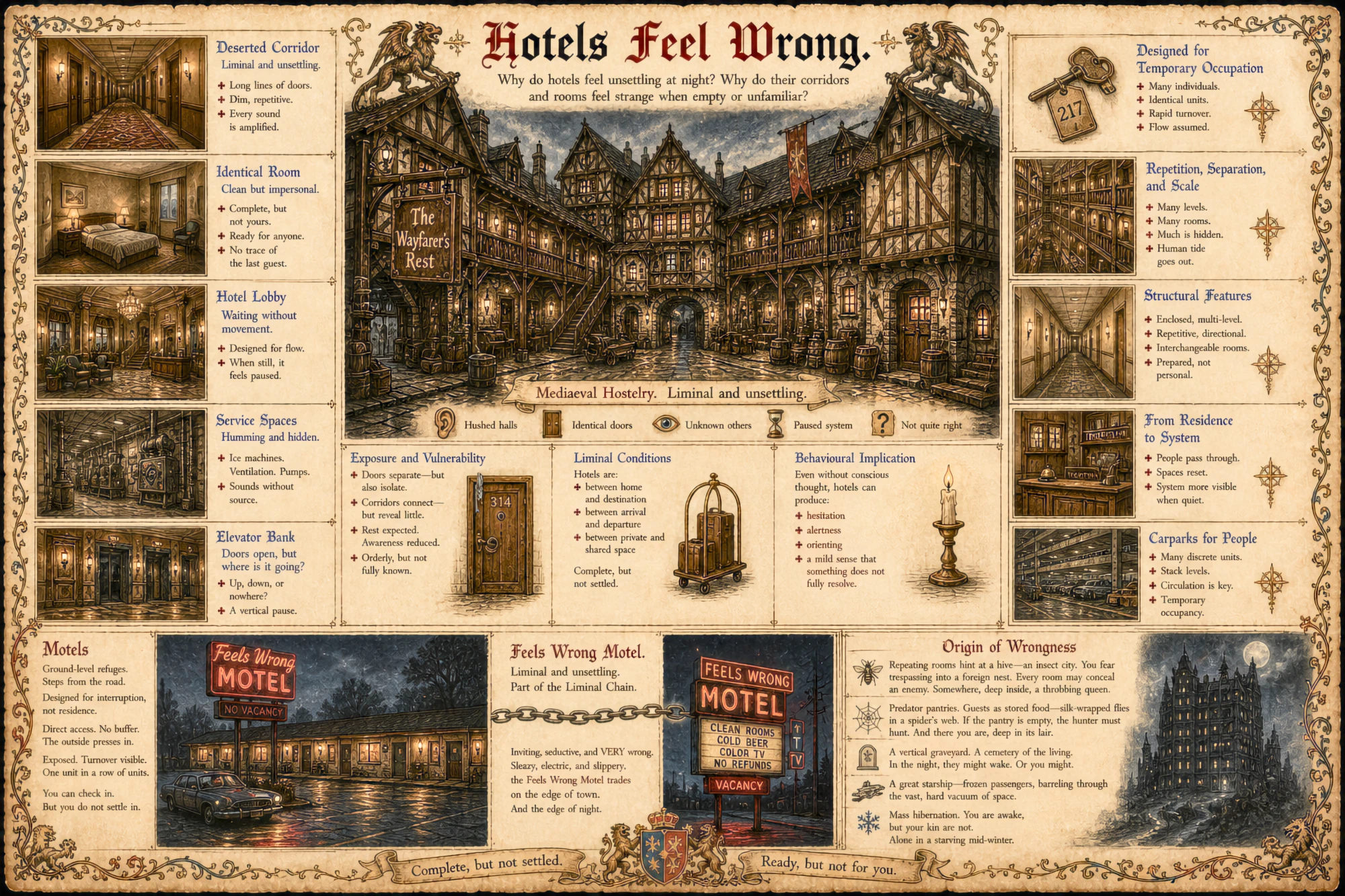
Why do hotels feel unsettling at night? Why do their corridors and rooms feel strange when empty or unfamiliar?
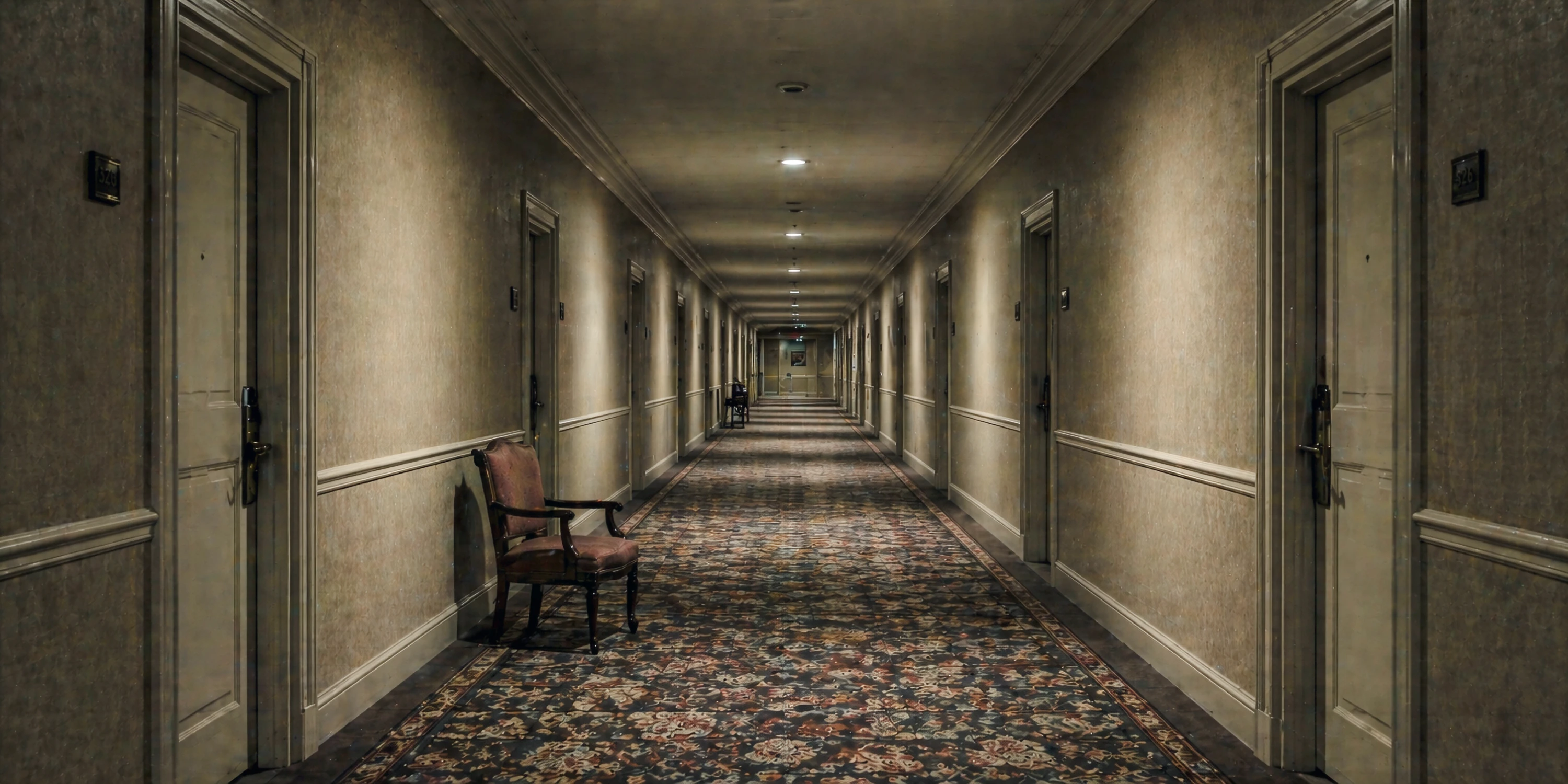
Long halls of identical doors under hushed lighting. The faint hum of an ice machine. Footsteps that sound too loud. A distant laugh.
You’re not imagining it. Many people notice a distinct shift in how hotels feel—especially when they are quiet, partially occupied, or experienced alone.
A long corridor with identical doors. A room that is clean but impersonal. An unfamiliar space designed to be used immediately.
It’s not just unfamiliarity. It’s something more immediate— a subtle, hard-to-explain sense that the space is not quite right.
It feels wrong.
Hotels are built for short-term use. They are designed to:
accommodate many individuals at once
separate occupants into identical units
allow rapid turnover between stays
Each room is complete, but not personal. Each corridor connects, but does not belong. The structure assumes constant arrival and departure. When this flow is absent—or not visible—the space changes.
Hotels share a distinctive architecture. Floors repeat. Corridors extend. Doors are numbered and interchangeable. Spaces are separated, but closely packed. This creates a layered structure:
many levels
many rooms
many unseen occupants
Even when occupied, much of the activity is hidden. When quiet, this hidden structure becomes more apparent (the human tide goes out). This is the resonance of the covert.
Hotels combine several conditions that affect how they are experienced. They are enclosed, multi-level environments with limited and controlled access. Their layout is repetitive and directional, built around circulation rather than gathering. Rooms are complete but interchangeable, designed for use without attachment. Everything is prepared—but not personalised. This creates a mismatch between the completeness of the space and the absence of any visible owner or context.
A hotel resembles a building full of rooms, but functions more like a system. People pass through. Spaces reset. Occupancy changes continuously. When quiet, this system becomes more visible. The building feels less like a place of residence and more like an arrangement of units awaiting use. This sense of paused transit feels wrong.
In structural terms, hotels resemble multi-storey carparks. Both:
organise large numbers of discrete units
stack levels vertically
rely on circulation through corridors or ramps
assume temporary occupancy
A carpark holds vehicles. A hotel holds people. When empty or quiet, both spaces can feel suspended—systems designed for movement and storage, experienced without either. Dallying is unsettling in high traffic zones. A hotel guest occupies an ersatz home, like a car occupies an ersatz garage of its own. Spaces are borrowed, not owned.
Hotels add another layer. Unlike carparks, they are spaces of rest. They assume sleep, privacy, and reduced awareness. You are expected to relax in a place that is unfamiliar, temporary, and structurally repetitive. Doors separate you from others—but also from context. Corridors connect you—but reveal little about who or what is nearby. This combination can produce a subtle sense of exposure. The space is controlled and orderly, but not fully known.
Hotels sit between states. They are:
between home and destination
between arrival and departure
between private and shared space
They are not fully inhabited in the way a home is, nor fully public in the way a street is. When quiet, this in-between condition becomes more pronounced. The space feels complete, but not settled. This liminality feels wrong.
Even without conscious thought, hotels can produce hesitation, alertness, or a mild urge to orient yourself—especially at night or when alone. The space is intact. Nothing is obviously wrong. But something does not fully resolve.
Motels are ground-level refuges—rooms you can step into directly from the outside. No lobby. No buffer. No ascent. Just a door, a number, and a strip of concrete between you and the road. They are designed for interruption, not residence. You arrive late. You leave early. The stay is provisional. The bed is a pause, not a place. This direct access is what makes them bowel stirring. There is no interior depth to retreat into—only a thin shell. The outside presses in. Cars idle a few metres away. Footsteps pass your door. Headlights sweep across the curtains. The boundary between private and public is weak and constantly tested. It is the exposed layer of the hive, buzzing and violated.
A motel room is yours, but not deeply yours. It has been occupied recently and will be occupied again soon. The turnover is visible. The fittings are standard. The layout is repeated. The individuality is stripped away. You are one unit in a row of units. Identical doors. Identical windows. Identical rooms. A series of interchangeable refuges, each one exposed.
There is always the sense that you could be observed, approached, entered. That someone might stop outside your door. That the door might not hold. That you are too close to the outside to relax, but too enclosed to leave without committing yourself to the dark.
Motels are not destinations. They are interruptions in transit—places where the journey stalls, but does not resolve. They echo an exposed hive, buzzing and violated, with each cubicle facing the outside.
You can check in. But you do not settle in.
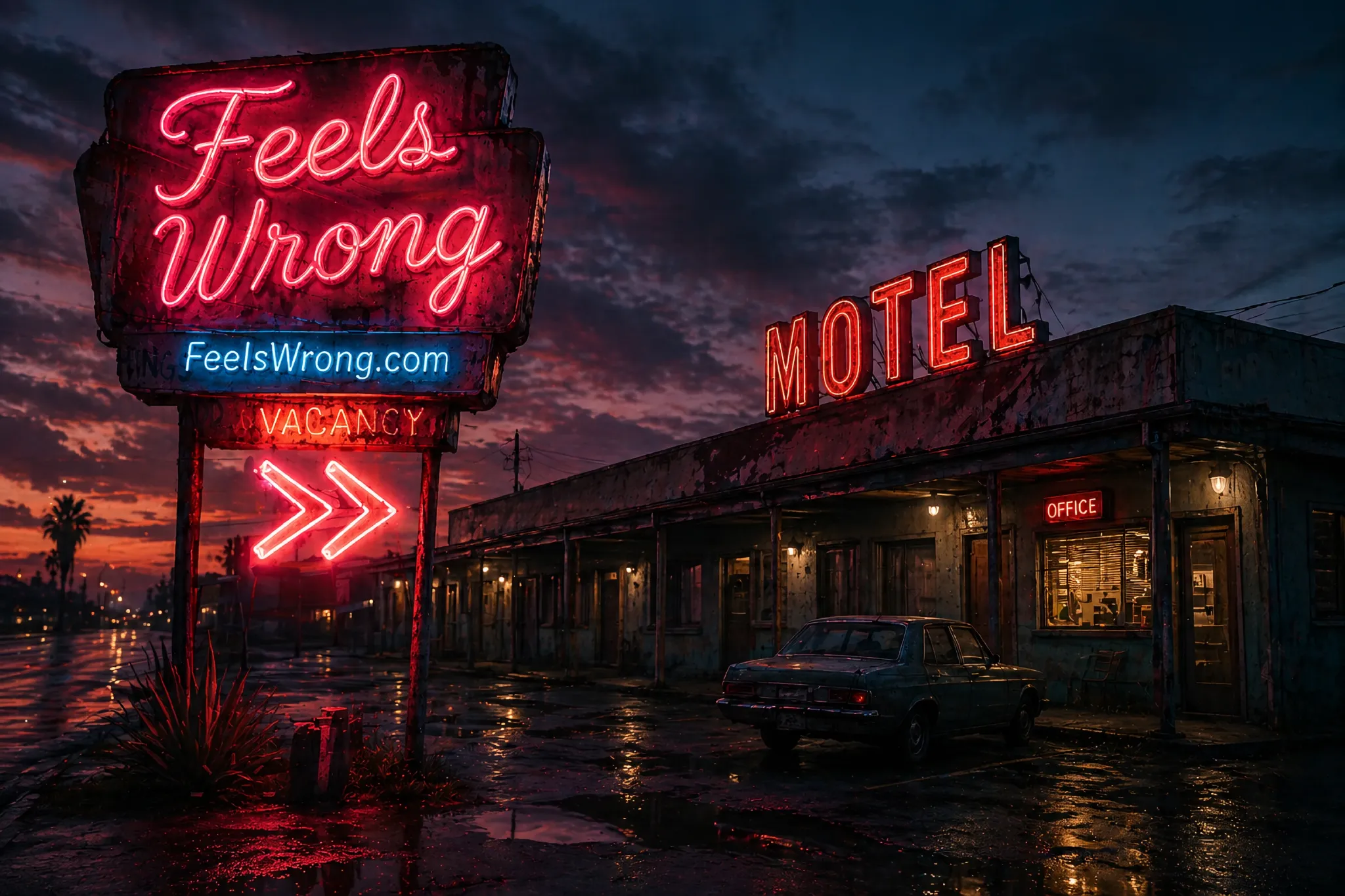
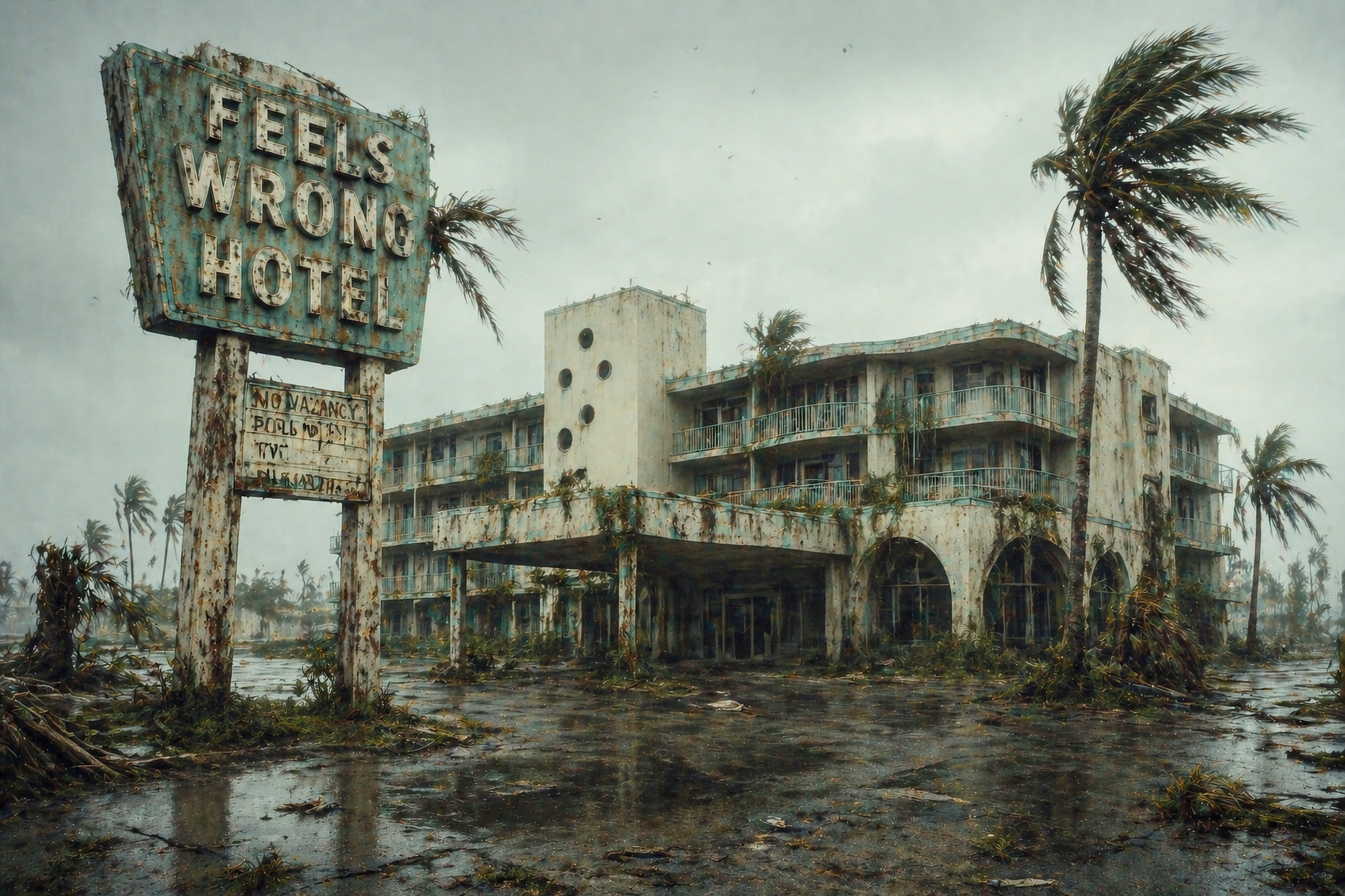
Inviting, seductive, and VERY wrong. Sleazy, electric, and slippery, the Feels Wrong Motel trades on the edge of town. And the edge of night.
Graphic created by ChatGPT and animated with Grok.
The repeating structures of rooms hint at a hive, creating the sense of an insect city. You fear that you have trespassed into a foreign nest. And that your pheromones don't match. And that every room conceals an enemy. And somewhere, deep inside, is a throbbing, evil queen birthing more soldiers.
Human storage arrays also hint at predator pantries, with the people as stored food—the guests being silk-wrapped flies in a spider's web. And if there is nothing in the pantry, then the hunter must hunt . And there you are, deep in its lair...
And all those unknown, sleeping bodies suggest a vertical graveyard. A cemetery of the living. And in the night, they might wake.
Or you might think of the hotel as a great starship, full of frozen passengers, barrelling through the vast, hard vacuum of space.
Or you might see it as a mass hibernation, and that you have woken, but your kin have not. And you are alone in a starving mid-winter.
In 1996, Russell Kightley completed a manuscript on what he called “bowel stirring things.” It remained unpublished for thirty years.
In 2026, he revived and refined it as Bowel Stirring Things: A Natural History of Mental Laxatives & The Bowel as Predator Detector—a study of unsettling places and the geometries that provoke an immediate, visceral response.